
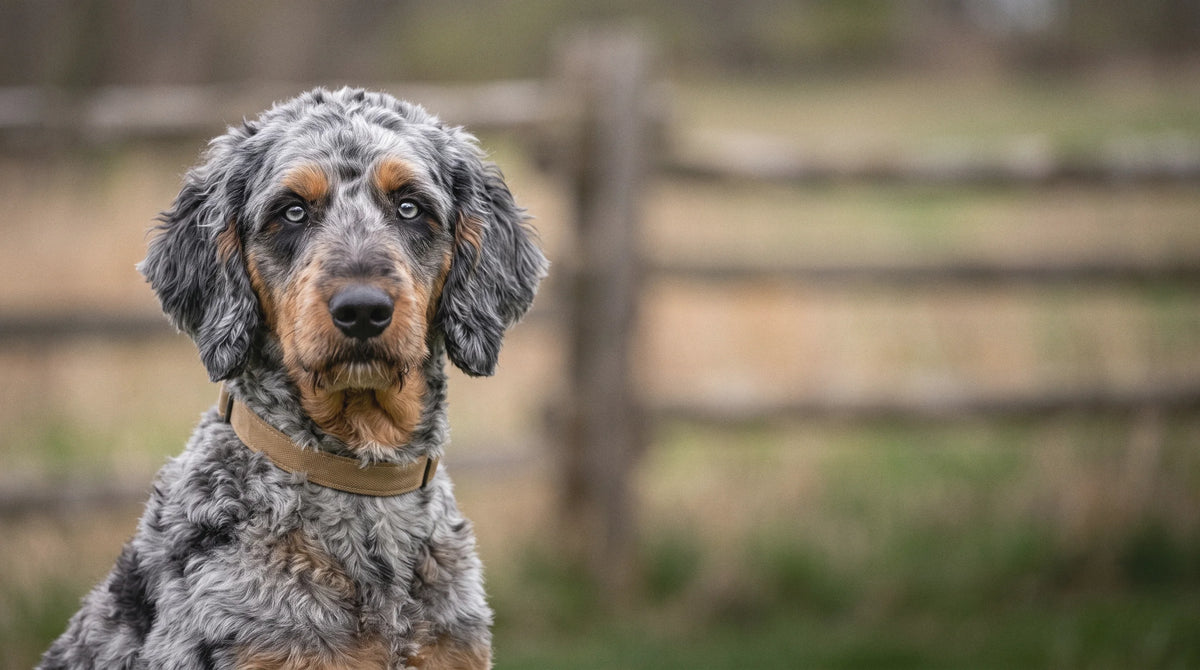
Standard Aussiedoodle
- Medium
The Standard Aussiedoodle crosses an Australian Shepherd with a Standard Poodle and can reach 70 pounds. It is a working cross with a herding parent and a hunting parent, and an hour of exercise a day is the floor.
- Weight
- ≤70
- pounds, adult
- Life expectancy
- 10 to 12
- years, median 11
- Senior from
- 8.3
- years, about
Senior starts in the last quarter of a breed's expected lifespan, following the 2019 AAHA canine life stage guidelines. Individual dogs vary.
About the breed
- Temperament
- Friendly, loving, intelligent, energetic, trainable, playful
- Coat
- Curly, Wavy, medium
The Standard Aussiedoodle is the larger of the two sizes PetMD names, growing to as much as 70 pounds against the Miniature's 30. Breeders began producing the cross in the 1990s, at the same time as the Goldendoodle, Cockapoo and Labradoodle.
Two working breeds meet here. Australian Shepherds were bred to herd and Poodles hunted waterfowl for centuries, and the result is a high-energy, highly intelligent dog that needs its mind kept busy. One that does not get that turns to chewing and digging, and its size makes both more expensive.
Nobody can promise you a light shedder. The Poodle side brings non-shedding curls and the Australian Shepherd side is a moderate shedder, so a Standard Aussiedoodle can be either. No dog is completely hypoallergenic.
The larger size also brings a specific risk. Large, deep-chested breeds like the Poodle are predisposed to bloat, and a standard Aussiedoodle may be too, which shapes how it should be fed. Colours span both parents, from jet black to blue merle, and lifespan is 10 to 12 years.
Care
The routines that matter most for this breed. Open one at a time.
Nutrition
A food whose label carries an Association of American Feed Control Officials (AAFCO) nutritional adequacy statement is the starting point, with a puppy formula until the first birthday and adult food after. An active dog of this size needs a diet with the protein and fat to fuel it and the vitamins A and D3 that support vision, immune function and bone.
Adults eat twice a day; puppies need three to four meals on a consistent schedule.
Bloat is why how you feed matters as much as what you feed. Keep your Standard Aussiedoodle from gulping food or water: use a slow-feeder bowl, skip raised bowls, and keep exercise away from mealtimes. Restlessness, drooling, retching without producing anything, panting, a distended stomach or collapse mean an emergency vet immediately.
Portions follow size, age and health. The bag gives a figure by weight and your vet gives a better one.
Grooming
There is a lot of coat on a Standard Aussiedoodle and it needs regular grooming and trims whatever its texture. Every dog in this cross is different: a curlier coat needs trimming and brushing more often than one that takes after the Australian Shepherd side, and a slicker brush is what keeps mats and tangles out of the longer ones.
Skin gets a specific check. Sebaceous adenitis is one of the most common genetic conditions in Poodles, so excessive flaking, scaling or thickening of the skin warrants a vet, and the condition is managed with routine baths and ointments rather than cured. Otherwise bathe as needed.
The eyes need little: wipe away gunk, keep the fur trimmed so it does not block vision, and report any change in or around them.
The ears need more. A Standard Aussiedoodle that has inherited the Poodle's love of water needs its ears cleaned with a dog-specific cleaner after every swim and every bath, or trapped moisture turns into an infection.
Exercise
An hour of movement a day is the minimum for a Standard Aussiedoodle, and one that takes after its Australian Shepherd parent will ask for more. Long walks and daily play are the baseline, not the programme.
Fetch, running and swimming are the cross's favourites, and the Poodle ancestry means the water is usually a hit. For structure, agility courses, lure chasing, dock jumping and hunting or retrieving work all suit a dog this size and this driven.
The fence matters. Herding and hunting instincts mean a Standard Aussiedoodle must be on a leash or inside a securely fenced area outdoors, because chasing a neighborhood animal or a car is a real risk rather than a theoretical one. A tall fence is the specific recommendation for a dog with the strong herding drive.
Keep hard exercise away from meals, given the bloat risk that comes with the deep chest.
Training
A Standard Aussiedoodle is highly trainable and loves having a task to accomplish, which is the most useful thing to know about it. Clicker training plays to the quick brain, and complicated tricks are a good use of it once the basics are in.
Prioritise stay and recall above everything else. Strong herding instincts and the urge to chase are what get this breed into dangerous situations, and at 70 pounds a dog that will not come back is not one you can catch.
Socialisation is what makes the friendliness reliable. Well-socialised Aussiedoodles get along with other pets and children, so put the time in early.
Feed the mind daily. Both parent breeds are extremely intelligent and need ample stimulation, and a Standard Aussiedoodle without it is the one that turns destructive. Puzzle toys and treat containers that have to be worked out are a cheap substitute for an afternoon you do not have.
Health conditions
5 conditions are documented for the Standard Aussiedoodle.
A predisposition is not a diagnosis. Ask your vet which screenings make sense for your dog's age.
- Autoimmune ThyroiditisHormonal
- Bloat (Gastric Dilatation-Volvulus)Digestive
- Elbow DysplasiaBone & Joint
- Hip DysplasiaBone & Joint
- Sebaceous AdenitisSkin & Connective Tissue
May inherit from parent breeds
These conditions are documented in the parent breeds, not in this cross itself. Carrier possible means the condition is recessive: a dog can carry it without showing signs. Ask the breeder which tests the parent dogs had.
- Addison's DiseaseMiniature Poodle, Standard Poodle, Toy Poodle
- BronchiectasisMiniature Poodle, Standard Poodle, Toy Poodle
- Canine Multifocal Retinopathy, cmr1Australian Shepherd
- CataractsAustralian Shepherd
- Chronic BronchitisMiniature Poodle, Standard Poodle, Toy Poodle
Show all 33 conditions Show fewer
- Collie Eye AnomalyCarrier possible · Australian Shepherd
- CryptorchidismMiniature Poodle, Standard Poodle, Toy Poodle
- DeafnessAustralian Shepherd
- Degenerative MyelopathyCarrier possible · Australian Shepherd
- DystociaMiniature Poodle, Standard Poodle, Toy Poodle
- Ectopic UreterMiniature Poodle, Standard Poodle, Toy Poodle
- Geriatric-onset laryngeal paralysis polyneuropathy, GOLPPMiniature Poodle, Standard Poodle, Toy Poodle
- HemangiosarcomaAustralian Shepherd
- Hereditary Cerebellar AtaxiaAustralian Shepherd
- Hip and Elbow DysplasiaAustralian Shepherd
- HypothyroidismMiniature Poodle, Standard Poodle, Toy Poodle
- Idiopathic epilepsy, including epilepsy of unknown originAustralian Shepherd, Miniature Poodle, Standard Poodle, Toy Poodle
- Immune-mediated thrombocytopeniaMiniature Poodle, Standard Poodle, Toy Poodle
- Intervertebral Disc DiseaseMiniature Poodle, Standard Poodle, Toy Poodle
- Iris ColobomaAustralian Shepherd
- Junctional Epidermolysis BullosaAustralian Shepherd
- LymphomaAustralian Shepherd
- MDR1 Drug SensitivityAustralian Shepherd
- Neuronal Ceroid Lipofuscinosis 8Carrier possible · Australian Shepherd
- Noise aversion (noise sensitivity; noise phobia when clinically diagnosed)Miniature Poodle, Standard Poodle, Toy Poodle
- Progressive Retinal AtrophyCarrier possible · Australian Shepherd
- Progressive Retinal Atrophy, prcdAustralian Shepherd
- Puerperal hypocalcemia (eclampsia)Miniature Poodle, Standard Poodle, Toy Poodle
- Systemic lupus erythematosusMiniature Poodle, Standard Poodle, Toy Poodle
- Systemic lupus erythematosus-associated polyarthritisMiniature Poodle, Standard Poodle, Toy Poodle
- Tracheal CollapseMiniature Poodle, Standard Poodle, Toy Poodle
- Tracheobronchial Collapse and BronchomalaciaMiniature Poodle, Standard Poodle, Toy Poodle
- Urate Kidney & Bladder StonesCarrier possible · Australian Shepherd

Longevity & Vitality soft chew
Longevity & Vitality is a daily chew built on five active ingredients. Each chew carries Turkey Tail at 600mg, Curcuvet® curcumin at 75mg, Quercefit® quercetin at 40mg, Fibalance® at 275mg and EpiCor® at 50mg. The daily serving follows your dog's weight, from half a chew to three.
