
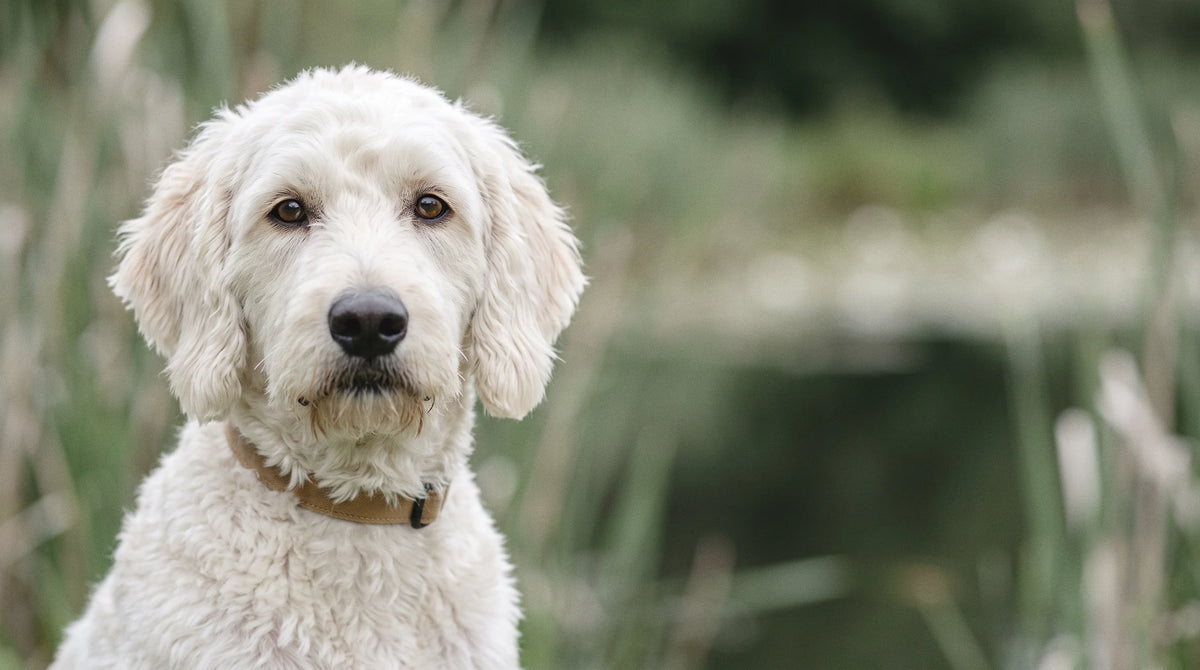
Medium Australian Labradoodle
- Medium
The Medium sits between the other two Australian Labradoodle sizes at 17 to 20 inches and 30 to 40 pounds. It is big enough to hike with and small enough to lift into the bath, with the same non-shedding coat.
- Height
- 17 to 20
- inches at the shoulder
- Weight
- 30 to 40
- pounds, adult
- Life expectancy
- 12 to 15
- years, median 13.5
- Senior from
- 10.1
- years, about
Senior starts in the last quarter of a breed's expected lifespan, following the 2019 AAHA canine life stage guidelines. Individual dogs vary.
About the breed
- Temperament
- Clever, sociable, comical, joyful, energetic, intuitive
- Coat
- Wavy, Curly, medium
- Origin
- Australia
The Medium Australian Labradoodle is the middle of the three size ranges in the ALAA standard: 17 to 20 inches at the wither, and not more than 21. Both clubs split the ideal by sex here, giving 17 to 19 inches for a female and 18 to 20 for a male. The ALCA puts the weight at 30 to 40 pounds.
One line in the ALCA standard is worth carrying into any conversation about this size: most Australian Labradoodles weigh more than their height reflects. Height is what the clubs measure, weight is what people guess from, and the two do not track each other as neatly as you would expect. The clubs also say plainly that sizes are still somewhat inconsistent and that even an experienced breeder cannot reliably predict adult size from a puppy.
Character is written once for the whole breed rather than per size: clever, sociable, comical and joyful, energetic off leash and quiet in the house, and expected to meet people happily with eye contact. The standard also asks for an intuition about the handler's state of mind, which is the quality behind the breed's use as a therapy and service dog.
The coat is single, non-shedding, and somewhere between a soft fleece and a looser wool. Any undercoat is a serious fault, and so is a coat that sheds.
Care
The routines that matter most for this breed. Open one at a time.
Nutrition
Pick a food meeting the Association of American Feed Control Officials (AAFCO) standards and matched to life stage, and keep water available. A Medium Australian Labradoodle on a complete diet should not need supplements unless a vet recommends them.
Feed an adult twice a day. Puppies under six months generally need more frequent meals than that. Twelve-hour intervals suit a dog of this size well: once-a-day feeding tends to produce anxiety and a fixation on the next bowl, and smaller, more frequent meals mean a dog that eats less at a sitting and usually more slowly.
At 30 to 40 pounds this size is easy to overfeed, and the coat hides it. The clubs prize an athletic, well-muscled dog with a good tuck-up, and that is a useful body-condition target to check your own dog against at home. Keep treats to 10 percent of daily calories, and skip table scraps.
A slow feeder helps a fast eater and buys a few minutes of mental work at the same time.
Grooming
A settled adult Australian Labradoodle coat needs combing out at least once a week, and the club is specific that the eight-to-twelve-month adolescent transition needs weekly attention without gaps. That transition is when most bad matting starts.
Which coat your dog has changes the work. The fleece coat is light and silky and can look almost straight or deeply waved; it rarely if ever sheds. The wool coat is denser, hangs in loose spirals, and is the more allergy-friendly of the two, but it is also the heavier grooming job. Neither should be thick, dense or tightly curled by the standard's account.
Get the comb to the skin, not just through the surface, and check where the coat rubs: behind the ears, between the legs and around the rear. The standard caps the coat at about four inches and asks that it not look overly groomed, so this is upkeep rather than sculpting. Sun bleaching is normal in an outdoor dog and is not a fault.
Keep the ear canals free of excess hair, which both standards call undesirable, and clean the ears after baths and swims.
Exercise
This is the size that does most things without compromise. A Medium Australian Labradoodle is substantial enough for a long hike and light enough to lift, and both club standards describe a dog whose trot should look purposeful and elastic, as if it were going somewhere.
Give it a solid hour most days, split however suits you. Walking, hiking, swimming, fetch and dock diving all fit, and agility fits particularly well because the breed is both quick to learn and built to move. The standard's line about being energetic when free and quiet when handled is a fair description of what you get in return for the hour.
Watch the growth window in a puppy. The ALCA warns that rapid growth in the larger sizes leads to structural problems, and while a Medium is not a Standard, the same caution applies to hard, repetitive exercise on a young dog. Build distance gradually.
Mental work counts. A clever dog with an unfilled day fills it itself.
Training
Keen and easy to train is what the standard says, and it holds. Positive reinforcement is the method; the standard faults nervous, yappy and highly-strung temperaments and treats any aggression or dominance as a major fault, so nothing about this dog calls for a heavy hand.
Teach grooming tolerance early and keep teaching it. A weekly comb-out for the dog's whole life is a lot of handling, and a Medium is big enough to make a fight of it if it decides to.
Socialise across the board. The temperament clause asks for a dog that approaches people happily and holds eye contact, and that is built by early, unhurried introductions rather than assumed. Rushed meetings with other dogs are the usual source of later problems.
This size is a common choice for therapy and assistance work, which comes from the intuition the standard asks for. If that is the direction you want, start the public-access socialisation early and work with a trainer who does that specific job.
Health conditions
6 conditions are documented for the Medium Australian Labradoodle.
A predisposition is not a diagnosis. Ask your vet which screenings make sense for your dog's age.
- Ear InfectionsEar & Hearing
- Elbow DysplasiaBone & Joint
- Exercise-Induced CollapseNervous System & Behavioral
- Hip DysplasiaBone & Joint
- Progressive Retinal AtrophyEye
Show all 6 conditions Show fewer
May inherit from parent breeds
These conditions are documented in the parent breeds, not in this cross itself. Carrier possible means the condition is recessive: a dog can carry it without showing signs. Ask the breeder which tests the parent dogs had.
- Acral Mutilation SyndromeCarrier possible · Cocker Spaniel, English Cocker Spaniel
- Addison's DiseaseMiniature Poodle, Standard Poodle, Toy Poodle
- Bacterial pyodermaLabrador Retriever
- BronchiectasisMiniature Poodle, Standard Poodle, Toy Poodle
- Carprofen-associated idiosyncratic hepatotoxicityLabrador Retriever
Show all 54 conditions Show fewer
- Centronuclear MyopathyCarrier possible · Labrador Retriever
- Chronic BronchitisMiniature Poodle, Standard Poodle, Toy Poodle
- Congenital Dyserythropoietic Anemia and PolymyopathyLabrador Retriever
- Congenital Myasthenic SyndromeLabrador Retriever
- Copper Toxicosis (Accumulating)Labrador Retriever
- Copper Toxicosis (Attenuating)Labrador Retriever
- Corneal DystrophyCarrier possible · Labrador Retriever
- CryptorchidismMiniature Poodle, Standard Poodle, Toy Poodle
- Cutaneous and renal glomerular vasculopathy, Alabama rotLabrador Retriever
- Day BlindnessLabrador Retriever
- Degenerative MyelopathyCarrier possible · Labrador Retriever
- DystociaMiniature Poodle, Standard Poodle, Toy Poodle
- Dystrophin-Deficient Muscular DystrophyLabrador Retriever
- Ectopic UreterLabrador Retriever, Miniature Poodle, Standard Poodle, Toy Poodle
- Geriatric-onset laryngeal paralysis polyneuropathy, GOLPPLabrador Retriever, Miniature Poodle, Standard Poodle, Toy Poodle
- Golden Retriever Progressive Retinal Atrophy 2Labrador Retriever
- Heat-related illness (including heatstroke)Labrador Retriever
- HemangiosarcomaLabrador Retriever
- Hereditary Nasal ParakeratosisCarrier possible · Labrador Retriever
- HypothyroidismCocker Spaniel, English Cocker Spaniel, Labrador Retriever, Miniature Poodle, Standard Poodle, Toy Poodle
- Idiopathic epilepsy, including epilepsy of unknown originLabrador Retriever, Miniature Poodle, Standard Poodle, Toy Poodle
- Idiopathic Functional Urinary Outflow ObstructionLabrador Retriever
- Immune-mediated polyarthritisLabrador Retriever
- Immune-mediated thrombocytopeniaMiniature Poodle, Standard Poodle, Toy Poodle
- Intervertebral Disc DiseaseCocker Spaniel, English Cocker Spaniel, Miniature Poodle, Standard Poodle, Toy Poodle
- Laryngeal ParalysisCarrier possible · Labrador Retriever
- Laryngeal Paralysis and PolyneuropathyLabrador Retriever
- Lyme-associated glomerulonephritis, presumptive Lyme nephritisLabrador Retriever
- Muscular DystrophyLabrador Retriever
- NarcolepsyCarrier possible · Labrador Retriever
- Noise aversion (noise sensitivity; noise phobia when clinically diagnosed)Miniature Poodle, Standard Poodle, Toy Poodle
- OsteoarthritisLabrador Retriever
- Primary uterine inertiaLabrador Retriever
- Progressive Retinal Atrophy, crd4/cord1Labrador Retriever
- Progressive Retinal Atrophy, prcdCocker Spaniel, English Cocker Spaniel, Labrador Retriever
- Puerperal hypocalcemia (eclampsia)Miniature Poodle, Standard Poodle, Toy Poodle
- Pyotraumatic folliculitis and furunculosisLabrador Retriever
- Sinonasal aspergillosisLabrador Retriever
- Skeletal Dysplasia 2Labrador Retriever
- Soft Palate HyperplasiaLabrador Retriever
- SRY-negative XX testicular or ovotesticular disorder of sex developmentCocker Spaniel, English Cocker Spaniel
- Stargardt DiseaseLabrador Retriever
- Succinic Semialdehyde Dehydrogenase DeficiencyCarrier possible · Labrador Retriever
- Systemic lupus erythematosusMiniature Poodle, Standard Poodle, Toy Poodle
- Systemic lupus erythematosus-associated polyarthritisMiniature Poodle, Standard Poodle, Toy Poodle
- Tracheal CollapseMiniature Poodle, Standard Poodle, Toy Poodle
- Tracheobronchial Collapse and BronchomalaciaMiniature Poodle, Standard Poodle, Toy Poodle
- Tricuspid Valve DysplasiaCarrier possible · Labrador Retriever
- Urate Kidney & Bladder StonesCarrier possible · Labrador Retriever
Health tests to ask the breeder for
The breed club asks breeders to run these tests on parent dogs. A required test is not a sign the breed is prone to the condition.
- Elbow DysplasiaClub requirement
- Exercise-Induced CollapseClub requirement
- Hip DysplasiaClub requirement
- Progressive Retinal AtrophyClub requirement

Sources
Thank you. Your report is in, and we will check this page.
Longevity & Vitality soft chew
Longevity & Vitality is a daily chew built on five active ingredients. Each chew carries Turkey Tail at 600mg, Curcuvet® curcumin at 75mg, Quercefit® quercetin at 40mg, Fibalance® at 275mg and EpiCor® at 50mg. The daily serving follows your dog's weight, from half a chew to three.
