
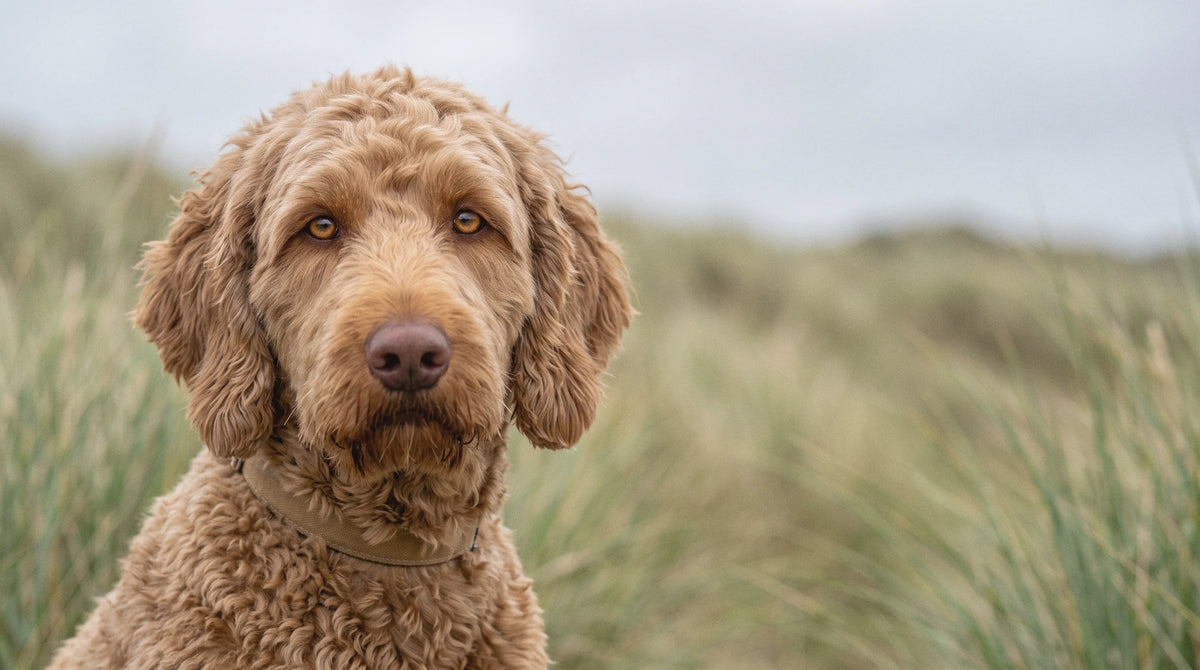
Standard Australian Labradoodle
- Medium
The Standard is the largest of the three Australian Labradoodle sizes, 21 to 24 inches at the wither and 50 to 65 pounds. It is a big, athletic, non-shedding dog that grew up as an assistance breed and is still trained as one.
- Height
- 21 to 24
- inches at the shoulder
- Weight
- 50 to 65
- pounds, adult
- Life expectancy
- 12 to 15
- years, median 13.5
- Senior from
- 10.1
- years, about
Senior starts in the last quarter of a breed's expected lifespan, following the 2019 AAHA canine life stage guidelines. Individual dogs vary.
About the breed
- Temperament
- Clever, sociable, comical, joyful, energetic, intuitive
- Coat
- Wavy, Curly, medium
- Origin
- Australia
The Standard Australian Labradoodle is the largest of the ALAA's three size ranges, at 21 to 24 inches at the wither and not more than 25. The clubs give the ideal as 21 to 23 inches for a female and 22 to 24 for a male, and the ALCA puts the weight at 50 to 65 pounds.
Frame matters more than bulk in this breed. The standard asks for a dog that is athletic and graceful with medium bone, appearing neither heavyset nor overly fine, square and compact with a deep chest and a good tuck-up. A Standard that reads as heavy has missed the target, not exceeded it, and oversize is a major fault in both standards.
The clubs are direct about the risk that comes with the size. Large dogs can grow fast enough to cause structural problems, so soundness is treated as paramount and any sign of lameness disqualifies. That is a breeding instruction, but it is also worth knowing as an owner of a fast-growing puppy.
Temperament and coat are the same across all three sizes. Expect a clever, sociable, comical dog that is energetic when loose and quiet indoors, with a single non-shedding coat somewhere between fleece and wool. The intuition the standard asks for about a handler's emotional state is why this size in particular turns up so often in assistance and therapy work.
Care
The routines that matter most for this breed. Open one at a time.
Nutrition
Feed a food meeting the Association of American Feed Control Officials (AAFCO) standards, matched to life stage, with water always available. Supplements are a vet's call and not a default: a dog of this size eating a complete diet is already getting what it needs.
Puppy feeding is where this size differs from the other two. The clubs warn that rapid growth in a large dog leads to structural problems, and diet is one of the few levers you actually hold over growth rate. Use a food formulated for large-breed puppies, feed the measured amount rather than free-feeding, and ask your vet whether your dog is growing too fast rather than assuming a big puppy is a healthy one.
Adults do best on two meals a day rather than one. Twelve-hour intervals are easier on the metabolism, they avoid the anxiety and meal-fixation that once-a-day feeding tends to produce, and they mean a deep-chested dog eats less at a sitting, which matters where gastric dilatation-volvulus is a risk.
Keep treats to 10 percent of daily calories and leave table scraps alone.
Grooming
A Standard carries the most coat of the three sizes, and the weekly comb-out the clubs recommend takes correspondingly longer. Build it into the week rather than fitting it in.
The adolescent transition between about eight and twelve months needs grooming every week without a gap, and on this size a missed fortnight is genuinely hard to recover from. Mats that reach the skin are painful and usually end in a full shave-down.
Comb to the skin in sections rather than brushing the outline, and pay attention to the friction points: behind the ears, the chest where the coat meets the front legs, the trousers and the tail. The standard caps the coat at about four inches, asks that it look even over the body, and specifically says it should not appear overly groomed. Sunning and colour bleaching are expected in an active outdoor dog and are not faults.
Ear canals should be kept free of excessive hair, and a dog this size that swims needs its ears dried and cleaned afterwards as a matter of routine.
Exercise
A Standard Australian Labradoodle needs about an hour a day and is built for it. The standards describe an effortless, powerful, coordinated trot with good reach in front and drive from behind, and a light, almost silent gait; that is a dog that wants distance.
Hiking, swimming, long walks, fetch and dock diving all suit the size. So does agility, though the clubs' warning about growth is worth heeding first: hold off on hard jumping and repetitive impact until the growth plates have closed, because rapid growth and structural problems are the risk this size actually carries.
Watch how your dog moves behind. The ALCA lists excessive tightness in the hips, which shows up as a stilted action, as a fault, and the club mandates hip screening of every breeding dog. If your dog's rear movement changes, see a vet rather than pushing through it.
Mental work still counts toward the hour.
Training
The ALAA standard calls the breed keen and easy to train, and at this size early training is not optional: a 60-pound dog that has not learned to walk on a leash is a different problem from a 20-pound one. Use positive reinforcement; there is no call for harsh correction. The standard lists any sign of aggression or dominance as a major fault, and timidity as well, so a well-bred Standard should not give you those problems in the first place.
Teach grooming and handling tolerance from the first week home. This dog will be combed weekly for its whole life and lifted onto a grooming table regularly, and consent to that is built in puppyhood or fought over later.
Socialise widely and slowly. The temperament clause asks for a dog that approaches people in a happy, friendly manner and offers eye contact, and the way to get there is unhurried introductions to as many people, dogs and places as you can manage before adolescence.
This is the size most often trained on for assistance work, which follows from the breed's origin: the standard's clause about knowing a handler's emotional state is what made the Australian Labradoodle an excellent dog for people with special needs, in its own words.
Health conditions
6 conditions are documented for the Standard Australian Labradoodle.
A predisposition is not a diagnosis. Ask your vet which screenings make sense for your dog's age.
- Ear InfectionsEar & Hearing
- Elbow DysplasiaBone & Joint
- Exercise-Induced CollapseNervous System & Behavioral
- Hip DysplasiaBone & Joint
- Progressive Retinal AtrophyEye
Show all 6 conditions Show fewer
May inherit from parent breeds
These conditions are documented in the parent breeds, not in this cross itself. Carrier possible means the condition is recessive: a dog can carry it without showing signs. Ask the breeder which tests the parent dogs had.
- Acral Mutilation SyndromeCarrier possible · Cocker Spaniel, English Cocker Spaniel
- Addison's DiseaseMiniature Poodle, Standard Poodle, Toy Poodle
- Bacterial pyodermaLabrador Retriever
- BronchiectasisMiniature Poodle, Standard Poodle, Toy Poodle
- Carprofen-associated idiosyncratic hepatotoxicityLabrador Retriever
Show all 54 conditions Show fewer
- Centronuclear MyopathyCarrier possible · Labrador Retriever
- Chronic BronchitisMiniature Poodle, Standard Poodle, Toy Poodle
- Congenital Dyserythropoietic Anemia and PolymyopathyLabrador Retriever
- Congenital Myasthenic SyndromeLabrador Retriever
- Copper Toxicosis (Accumulating)Labrador Retriever
- Copper Toxicosis (Attenuating)Labrador Retriever
- Corneal DystrophyCarrier possible · Labrador Retriever
- CryptorchidismMiniature Poodle, Standard Poodle, Toy Poodle
- Cutaneous and renal glomerular vasculopathy, Alabama rotLabrador Retriever
- Day BlindnessLabrador Retriever
- Degenerative MyelopathyCarrier possible · Labrador Retriever
- DystociaMiniature Poodle, Standard Poodle, Toy Poodle
- Dystrophin-Deficient Muscular DystrophyLabrador Retriever
- Ectopic UreterLabrador Retriever, Miniature Poodle, Standard Poodle, Toy Poodle
- Geriatric-onset laryngeal paralysis polyneuropathy, GOLPPLabrador Retriever, Miniature Poodle, Standard Poodle, Toy Poodle
- Golden Retriever Progressive Retinal Atrophy 2Labrador Retriever
- Heat-related illness (including heatstroke)Labrador Retriever
- HemangiosarcomaLabrador Retriever
- Hereditary Nasal ParakeratosisCarrier possible · Labrador Retriever
- HypothyroidismCocker Spaniel, English Cocker Spaniel, Labrador Retriever, Miniature Poodle, Standard Poodle, Toy Poodle
- Idiopathic epilepsy, including epilepsy of unknown originLabrador Retriever, Miniature Poodle, Standard Poodle, Toy Poodle
- Idiopathic Functional Urinary Outflow ObstructionLabrador Retriever
- Immune-mediated polyarthritisLabrador Retriever
- Immune-mediated thrombocytopeniaMiniature Poodle, Standard Poodle, Toy Poodle
- Intervertebral Disc DiseaseCocker Spaniel, English Cocker Spaniel, Miniature Poodle, Standard Poodle, Toy Poodle
- Laryngeal ParalysisCarrier possible · Labrador Retriever
- Laryngeal Paralysis and PolyneuropathyLabrador Retriever
- Lyme-associated glomerulonephritis, presumptive Lyme nephritisLabrador Retriever
- Muscular DystrophyLabrador Retriever
- NarcolepsyCarrier possible · Labrador Retriever
- Noise aversion (noise sensitivity; noise phobia when clinically diagnosed)Miniature Poodle, Standard Poodle, Toy Poodle
- OsteoarthritisLabrador Retriever
- Primary uterine inertiaLabrador Retriever
- Progressive Retinal Atrophy, crd4/cord1Labrador Retriever
- Progressive Retinal Atrophy, prcdCocker Spaniel, English Cocker Spaniel, Labrador Retriever
- Puerperal hypocalcemia (eclampsia)Miniature Poodle, Standard Poodle, Toy Poodle
- Pyotraumatic folliculitis and furunculosisLabrador Retriever
- Sinonasal aspergillosisLabrador Retriever
- Skeletal Dysplasia 2Labrador Retriever
- Soft Palate HyperplasiaLabrador Retriever
- SRY-negative XX testicular or ovotesticular disorder of sex developmentCocker Spaniel, English Cocker Spaniel
- Stargardt DiseaseLabrador Retriever
- Succinic Semialdehyde Dehydrogenase DeficiencyCarrier possible · Labrador Retriever
- Systemic lupus erythematosusMiniature Poodle, Standard Poodle, Toy Poodle
- Systemic lupus erythematosus-associated polyarthritisMiniature Poodle, Standard Poodle, Toy Poodle
- Tracheal CollapseMiniature Poodle, Standard Poodle, Toy Poodle
- Tracheobronchial Collapse and BronchomalaciaMiniature Poodle, Standard Poodle, Toy Poodle
- Tricuspid Valve DysplasiaCarrier possible · Labrador Retriever
- Urate Kidney & Bladder StonesCarrier possible · Labrador Retriever
Health tests to ask the breeder for
The breed club asks breeders to run these tests on parent dogs. A required test is not a sign the breed is prone to the condition.
- Elbow DysplasiaClub requirement
- Exercise-Induced CollapseClub requirement
- Hip DysplasiaClub requirement
- Progressive Retinal AtrophyClub requirement

Sources
Thank you. Your report is in, and we will check this page.
Longevity & Vitality soft chew
Longevity & Vitality is a daily chew built on five active ingredients. Each chew carries Turkey Tail at 600mg, Curcuvet® curcumin at 75mg, Quercefit® quercetin at 40mg, Fibalance® at 275mg and EpiCor® at 50mg. The daily serving follows your dog's weight, from half a chew to three.
