
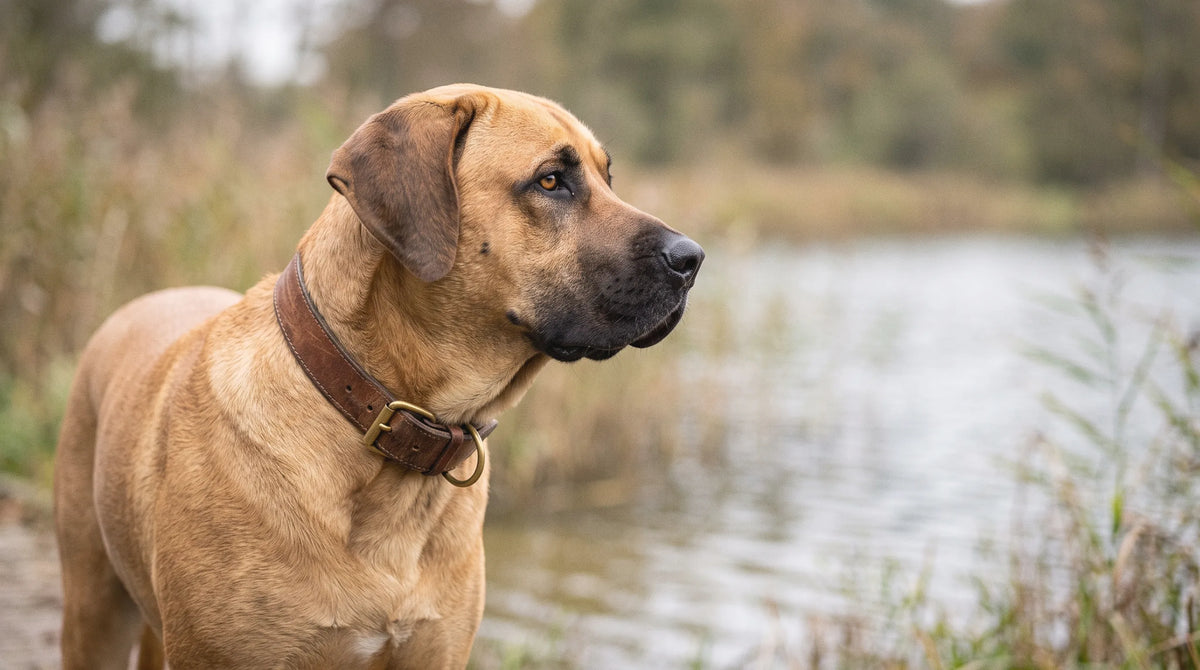
Broholmer
- Giant
- Foundation Stock Service
The Broholmer is a giant mastiff-type dog from Denmark that weighs 90 to 150 pounds. Calm, docile, and loyal, it is a gentle guardian bred to watch homes, cattle, and city markets, and it stays close to its family.
- Height
- 27.5 to 29.5
- inches at the shoulder
- Weight
- 90 to 150
- pounds, adult
- Life expectancy
- 8 to 10
- years, median 9
- Senior from
- 6.8
- years, about
Senior starts in the last quarter of a breed's expected lifespan, following the 2019 AAHA canine life stage guidelines. Individual dogs vary.
About the breed
- Temperament
- Friendly, loving, watchful
- Coat
- Smooth, short
- Origin
- Denmark
The Broholmer is a large, mastiff-type dog with a rectangular, strongly built body and a wide, massive head. A giant breed, it stands about 27.5 to 29.5 inches tall and weighs between 90 and 150 pounds. The Broholmer is calm, docile, and even-tempered, with a resounding bark and a confident walk.
This is a Molosser breed from Denmark, bred by crossing English Mastiffs with local German dogs. A Danish dog book from around 1800 called it very ordinary, especially around Copenhagen, where its habit of lying at the doorsteps of butcher shops earned it the nickname the butcher's dog. The Broholmer guarded homes, cattle, and city markets, often watching over the homes of the wealthy.
The Broholmer's numbers fell sharply during World War II, but the population has been rising steadily since the 1970s. Today these big dogs more often serve as gentle companions, friendly and loving toward their families, though they keep their watchful, protective tendencies. The Broholmer may be wary of strangers, yet it stays loyal and affectionate at home.
Temperament and needs
Scored 1 to 5 for the breed overall. Individual dogs vary.
- Affectionate with family3 out of 5
- Good with young children3 out of 5
- Good with other dogs3 out of 5
- Openness to strangers3 out of 5
- Playfulness3 out of 5
- Watchdog and protective nature4 out of 5
- Adaptability3 out of 5
- Trainability3 out of 5
- Energy level2 out of 5
- Mental stimulation needs3 out of 5
- Barking level1 out of 5
- Shedding3 out of 5
- Grooming frequency1 out of 5
- Drooling3 out of 5
Care
The routines that matter most for this breed. Open one at a time.
Nutrition
The Broholmer does well on a high-quality dog food, whether commercially manufactured or home-prepared under your veterinarian's supervision and approval. Match the diet to its life stage, whether puppy, adult, or senior, and keep clean, fresh water available at all times.
Some dogs are prone to weight gain, and the Broholmer is one of them, so watch its calorie intake and weight closely. Measure its food and monitor its portions. Treats help with training, but too many can contribute to weight gain.
Learn which human foods are safe for dogs and which are not. Check with your vet if you have any concerns about its weight or diet.
Grooming
The Broholmer has a short, smooth coat that needs little upkeep. Regular weekly grooming and occasional baths keep it clean and neat.
Trim its strong, fast-growing nails regularly with a clipper or grinder. Left too long, nails split, crack, and create problems with walking.
Check its ears often to avoid a buildup of wax and debris, which can lead to infection. Brush its teeth regularly and keep a consistent dental care routine.
Exercise
Given its size, the Broholmer is surprisingly agile. The Broholmer is not particularly high-spirited, but it loves being outdoors where it can play. Without daily exercise, it can develop behavioral problems, so plan on play in a fenced backyard or several walks a day.
Outdoor activities like swimming, hiking, and retrieving balls or flying discs give it a good outlet. Most Broholmers also enjoy hide-and-seek and catching frisbees, and training for dog sports such as agility, obedience, and rally keeps it moving. The Broholmer is happy to tag along for camping, hiking, a trip to the park, or a stroll around the neighborhood.
Indoor options work too, including hide-and-seek, chasing a ball rolled along the floor, or learning new tricks. These activities work its body and its mind. If you keep activity to your yard, make sure the area is fenced and secure.
Training
Training a Broholmer is relatively easy. The Broholmer is intelligent and eager to please, but it can also be stubborn, so you need to take charge as the leader. Continue training throughout its life to prevent future disobedience.
The Broholmer is generally not aggressive toward people or other dogs, and it does well with children and other dogs. Because it seems to underestimate its size, supervise it closely with both, and it suits families with older children who know how to approach and play with large dogs.
Even though it is even-tempered, early socialization is always a good idea. It helps your pup grow into a well-adjusted adult dog.
Health conditions
14 conditions are documented for the Broholmer.
A predisposition is not a diagnosis. Ask your vet which screenings make sense for your dog's age.
- Annuloaortic EctasiaHeart
- Atopic DermatitisSkin & Connective Tissue
- Bloat (Gastric Dilatation-Volvulus)Digestive
- Cranial Cruciate Ligament DiseaseBone & Joint
- CryptorchidismUrinary & Reproductive
Show all 14 conditions Show fewer
- Degenerative MyelopathyNervous System & Behavioral
- Elbow DysplasiaBone & Joint
- Hip DysplasiaBone & Joint
- LipomaSkin & Connective Tissue
- Mitral Valve DiseaseHeart
- Osteochondritis DissecansBone & Joint
- Sebaceous CystsSkin & Connective Tissue
- SpondylosisBone & Joint
- Subaortic StenosisHeart
Sources
Thank you. Your report is in, and we will check this page.
Longevity & Vitality soft chew
Longevity & Vitality is a daily chew built on five active ingredients. Each chew carries Turkey Tail at 600mg, Curcuvet® curcumin at 75mg, Quercefit® quercetin at 40mg, Fibalance® at 275mg and EpiCor® at 50mg. The daily serving follows your dog's weight, from half a chew to three.
