
Chipoo
- Toy
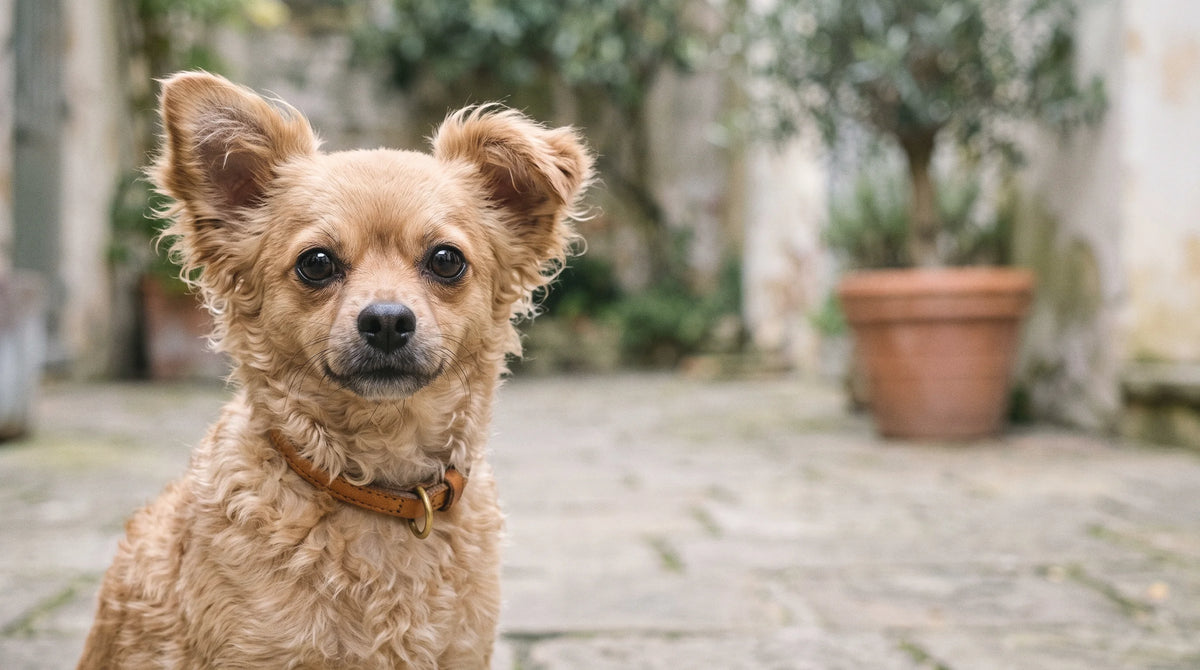
The Chipoo crosses a Chihuahua with a Miniature or Toy Poodle, giving a 4 to 15 pound dog that is lap-sized without actually being a lap dog. It is friendly and adaptable, and busier than the size suggests.
- Weight
- 4 to 15
- pounds, adult
- Life expectancy
- 14 to 16
- years, median 15
- Senior from
- 11.3
- years, about
Senior starts in the last quarter of a breed's expected lifespan, following the 2019 AAHA canine life stage guidelines. Individual dogs vary.
About the breed
- Temperament
- Affectionate, playful, adaptable, alert, intelligent, sociable
- Coat
- Curly, Smooth, medium
The Chipoo mixes two breeds of some international standing: the Chihuahua, a national symbol of Mexico, and the Poodle, the national dog of France. The American Kennel Club recognises neither the cross nor a standard for it, so the parents do the work of prediction.
Chihuahuas top out at 6 pounds and are compact, confident dogs with firm views about being on your lap. Poodles were bred to retrieve fowl from icy water, and the Miniature at 10 to 15 pounds and the Toy at 4 to 6 are no less intelligent or agile for being small. A full-grown Chipoo weighs 4 to 15 pounds.
Lap-sized is not the same as a lap dog. Both parent breeds are relatively high in energy and Poodles in particular need real mental and physical work every day, which the Chipoo's size lets you deliver indoors.
Expect an affectionate, playful, adaptable dog that makes friends across age groups, and treat close companionship as a requirement rather than a preference. The size warrants caution: very small children and very large dogs can hurt a Chipoo by accident, so supervise the meetings. Lifespan is 14 to 16 years.
Care
The routines that matter most for this breed. Open one at a time.
Nutrition
There is no single right way to feed a Chipoo. Build a plan with your vet that is complete and balanced for your dog's life stage, weight and health, and check the kibble size, because small teeth need small kibble.
Make sure the food meets Association of American Feed Control Officials (AAFCO) standards, so your dog gets everything it needs.
Puppies need three or four meals a day to avoid hypoglycaemia. Adults can be fed two or three times a day, and your vet can pick the schedule.
Portions start with the label's guide by weight and get refined by your vet against body condition score, lifestyle and health. Keep treats under 10 percent of daily calories. Dogs with a luxating patella sometimes benefit from supplements, and dental chews are worth raising given the periodontal risk, but both are conversations with your vet rather than purchases.
Grooming
Grooming a Chipoo is relatively light work, which is unusual for a Poodle cross. Both parent breeds sit fairly low on the shedding spectrum, and a thorough brushing at least twice a week is generally enough to keep the coat healthy and free of tangles.
What you are brushing varies. A Chipoo may inherit the Poodle's long curls, the Chihuahua's smooth short-to-medium coat, or something between, and the curlier the coat the more the twice-weekly minimum becomes a floor rather than a target.
Teeth are where the real routine goes. Small and toy breeds are especially prone to periodontal disease, and the Chihuahua parent brings crowded teeth in a small mouth with it. Brush at home ideally every day, and book professional cleanings when your vet recommends them.
Use a harness rather than a collar. Both Chihuahuas and Toy Poodles carry an increased risk of tracheal collapse, and pressure on the neck makes the cough worse, so the walking kit is part of the health plan.
Exercise
A Chipoo needs daily exercise for its body and its brain, and the useful part is that its size lets almost all of it happen indoors. Both parents are relatively high-energy, and Poodles specifically need a real quantity of mental stimulation every day.
Play does most of the work here. What this cross needs is daily play with you that works body and brain, more than a set number of minutes on a leash.
Watch the conditions that make a tracheal cough worse while you plan the day: heat and humidity, excitement and exertion all bring it on in an affected dog, so a hot afternoon is the wrong time for the energetic half of the routine.
Boredom has a specific symptom in this cross. A lonely Chipoo with energy to spare barks, and both parent breeds are good at it.
Training
Start socialising the puppy safely and early, exposing it to new animals, people, environments and objects while it is still forming its view of the world. A confident small dog is a socialised small dog.
Expect a personality that could come from either side. A Chipoo may be sassy and alert like the Chihuahua, active, agile and social like the Poodle, or a mix of both, and the training approach follows the dog you actually have.
What both parents share is being highly affectionate, playful and adaptable, which is good raw material. Reward-based training suits it, and daily interaction with you is part of the programme rather than a break from it.
Address barking early, since it is the behaviour a bored, lonely Chipoo reaches for and both parent breeds have a talent for it. Giving the dog something to do is most of the fix.
Health conditions
4 conditions are documented for the Chipoo.
A predisposition is not a diagnosis. Ask your vet which screenings make sense for your dog's age.
- Dental DiseaseOral & Dental
- Legg-Calve-Perthes DiseaseBone & Joint
- Patellar LuxationBone & Joint
- Tracheal CollapseAirway & Lung
May inherit from parent breeds
These conditions are documented in the parent breeds, not in this cross itself. Carrier possible means the condition is recessive: a dog can carry it without showing signs. Ask the breeder which tests the parent dogs had.
- Acquired myasthenia gravisChihuahua
- Addison's DiseaseMiniature Poodle, Toy Poodle
- BronchiectasisMiniature Poodle, Toy Poodle
- Chronic BronchitisMiniature Poodle, Toy Poodle
- CryptorchidismChihuahua, Miniature Poodle, Toy Poodle
Show all 32 conditions Show fewer
- DyschondroplasiaMiniature Poodle
- DystociaChihuahua, Miniature Poodle, Toy Poodle
- Ear InfectionsToy Poodle
- Ectopic UreterMiniature Poodle, Toy Poodle
- Eye ProblemsChihuahua, Miniature Poodle
- Geriatric-onset laryngeal paralysis polyneuropathy, GOLPPMiniature Poodle, Toy Poodle
- Heart DiseaseChihuahua
- HydrocephalusChihuahua
- HypoglycemiaChihuahua
- HypothyroidismMiniature Poodle, Toy Poodle
- Idiopathic epilepsy, including epilepsy of unknown originMiniature Poodle, Toy Poodle
- Immune-mediated thrombocytopeniaMiniature Poodle, Toy Poodle
- Intervertebral Disc DiseaseChihuahua, Miniature Poodle, Toy Poodle
- Mitral Valve DiseaseMiniature Poodle
- Neuronal Ceroid Lipofuscinosis 7Carrier possible · Chihuahua
- Noise aversion (noise sensitivity; noise phobia when clinically diagnosed)Miniature Poodle, Toy Poodle
- Noninfectious rhinitisChihuahua
- ObesityChihuahua
- Progressive Retinal AtrophyCarrier possible · Toy Poodle
- Progressive Retinal Atrophy, crd4/cord1Chihuahua
- Progressive Retinal Atrophy, prcdChihuahua
- Puerperal hypocalcemia (eclampsia)Chihuahua, Miniature Poodle, Toy Poodle
- Spinocerebellar Ataxia with Myokymia and/or SeizuresChihuahua
- Systemic lupus erythematosusMiniature Poodle, Toy Poodle
- Systemic lupus erythematosus-associated polyarthritisMiniature Poodle, Toy Poodle
- Tracheobronchial Collapse and BronchomalaciaChihuahua, Miniature Poodle, Toy Poodle
- Von Willebrand DiseaseToy Poodle



Longevity & Vitality soft chew
Longevity & Vitality is a daily chew built on five active ingredients. Each chew carries Turkey Tail at 600mg, Curcuvet® curcumin at 75mg, Quercefit® quercetin at 40mg, Fibalance® at 275mg and EpiCor® at 50mg. The daily serving follows your dog's weight, from half a chew to three.
