
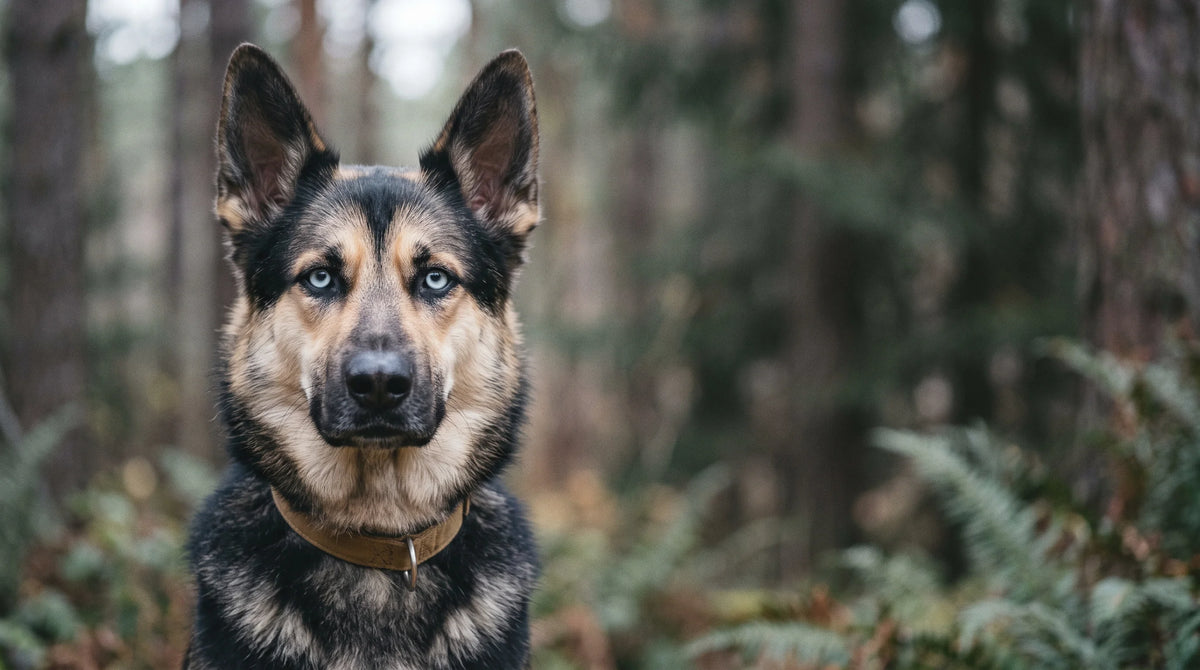
Gerberian Shepsky
- Medium
The Gerberian Shepsky crosses a German Shepherd with a Siberian Husky and weighs 40 to 60 pounds. It packs outsized energy and intelligence into a medium-size body, and it is not a breed for a first-time owner.
- Weight
- 40 to 60
- pounds, adult
- Life expectancy
- 10 to 14
- years, median 12
- Senior from
- 9
- years, about
Senior starts in the last quarter of a breed's expected lifespan, following the 2019 AAHA canine life stage guidelines. Individual dogs vary.
About the breed
- Temperament
- Intelligent, energetic, loyal, affectionate, alert, athletic
- Coat
- Double, medium
The Gerberian Shepsky is a German Shepherd crossed with a Siberian Husky. It is still a relatively rare cross with no breed standard, so definitive statements about appearance and temperament are not available and the two very well documented parents do the predicting.
Nobody knows when or why the first one was bred. The common guess is that somebody wanted a smaller German Shepherd with a Husky's piercing blue eyes, which is a guess rather than a history.
The parents pull in different social directions and that is the most useful thing to know. The German Shepherd standard describes a confident, direct, fearless dog, noble and focused and reserved, explicitly not one for making immediate and indiscriminate friendships. The Siberian Husky standard describes a friendly, gentle, eager-to-please dog bred for endurance sled work. Which way a given Shepsky leans varies from puppy to puppy.
What both parents share is the top of the charts for energy, intelligence and stimulation needs, and both shed their double coats prodigiously while otherwise asking little of a groomer. A Shepsky needs early socialisation and consistent positive reinforcement training, and is not recommended for first-time owners. Lifespan is 10 to 14 years.
Care
The routines that matter most for this breed. Open one at a time.
Nutrition
Feed a Gerberian Shepsky for the working dog it is rather than the size it looks. Two parents at the top of the energy charts produce a dog whose daily requirement is set by activity as much as by weight, so agree the plan with your vet.
Match the food to the life stage and adjust as the dog matures, which matters in a cross whose adult weight can land anywhere between 40 and 60 pounds.
Keep the dog lean throughout its life. Hip and elbow dysplasia both run in this cross, both are hereditary, and your dog's weight is the one factor you control directly. Reluctance to get up or jump, limping that is worse after exercise, weight shifting onto the front legs or a grating sound from a joint all warrant a vet appointment rather than a rest day.
Joint support is a reasonable thing to ask your vet about in a dog with this parentage, but do not add it on your own.
Grooming
Both parent breeds excel at shedding their double coats, and the standing advice is to keep a lint roller handy. Beyond that a Gerberian Shepsky does not require much grooming at all.
Weekly brushing and the occasional bath is the whole routine, with more attention when the coat turns over.
The eyes are where the real vigilance goes, because several hereditary conditions are more common in both parents. Pannus, also called chronic superficial keratitis, shows as a pinkish film spreading inward from the outer edge of the eye and turning opaque as the cornea darkens; it is incurable and leads to blindness untreated, though topical medication can slow it and sometimes achieve remission.
Juvenile hereditary cataracts, corneal dystrophy and late-onset progressive retinal atrophy sit alongside it. Any cloudiness, colour change, redness or new clumsiness is a reason to get the eyes examined properly rather than watched.
Exercise
Gerberian Shepskies need copious amounts of mental and physical activity, a holdover from their parents' working days as sheep herders and sled dogs.
No numeric figure is published for the cross, so read the dog rather than a target. What is certain is that a walk around the block is not the answer for an animal descended from two breeds bred to work all day.
Give the mind equal billing. The offspring of two working breeds needs outlets for keeping body and mind active, and a Shepsky with a tired body and an idle brain is only half settled.
Plan where the exercise happens as carefully as what it is. Keep a Husky-descended dog with this much energy on a leash or in a fenced space until you know the recall is reliable.
Training
Gerberian Shepskies are not recommended for first-time owners, and the reason is specific: they need early socialisation and consistent positive reinforcement training to thrive, and both parents are demanding animals in different ways.
Expect the temperament to vary. Mixing a reserved, focused German Shepherd with an outgoing, eager-to-please Husky produces a combination of traits from each, and with no breed standard to steer it the result varies from puppy to puppy. Train the dog you have.
Socialise early and widely, particularly if your dog leans toward the German Shepherd side, since the German Shepherd standard describes a dog not given to immediate and indiscriminate friendships.
Both parents can be loyal, loving family companions, including with children, but that comes from the early work, and you should not count on it without it.
Health conditions
7 conditions are documented for the Gerberian Shepsky.
A predisposition is not a diagnosis. Ask your vet which screenings make sense for your dog's age.
- CataractsEye
- Corneal DystrophyEye
- Degenerative MyelopathyNervous System & Behavioral
- Elbow DysplasiaBone & Joint
- Hip DysplasiaBone & Joint
Show all 7 conditions Show fewer
May inherit from parent breeds
These conditions are documented in the parent breeds, not in this cross itself. Carrier possible means the condition is recessive: a dog can carry it without showing signs. Ask the breeder which tests the parent dogs had.
- AllergiesGerman Shepherd
- Azathioprine-associated hepatotoxicosisGerman Shepherd
- Bacterial pyodermaGerman Shepherd
- Bloat (Gastric Dilatation-Volvulus)German Shepherd
- BronchiectasisSiberian Husky
Show all 43 conditions Show fewer
- CancerGerman Shepherd
- Canine Leukocyte Adhesion Deficiency Type IIIGerman Shepherd
- CryptorchidismGerman Shepherd, Siberian Husky
- Day BlindnessSiberian Husky
- Degenerative lumbosacral stenosisGerman Shepherd
- Discoid Lupus ErythematosusGerman Shepherd, Siberian Husky
- DiscospondylitisGerman Shepherd
- Ectopic UreterSiberian Husky
- Eosinophilic BronchopneumopathySiberian Husky
- Exocrine Pancreatic InsufficiencyGerman Shepherd
- Heart DiseaseGerman Shepherd
- Hemophilia ACarrier possible · German Shepherd
- Hip and Elbow DysplasiaGerman Shepherd
- HypothyroidismGerman Shepherd, Siberian Husky
- IchthyosisGerman Shepherd
- Idiopathic epilepsy, including epilepsy of unknown originGerman Shepherd, Siberian Husky
- Idiopathic Functional Urinary Outflow ObstructionGerman Shepherd
- Idiopathic lymphoplasmacytic rhinitisGerman Shepherd
- Immune-mediated polyarthritisGerman Shepherd
- Immune-mediated thrombocytopeniaGerman Shepherd
- MDR1 Drug SensitivityGerman Shepherd
- Mucocutaneous lupus erythematosusGerman Shepherd
- Mucocutaneous pyodermaGerman Shepherd
- Mucopolysaccharidosis Type VIIGerman Shepherd
- Mucous membrane pemphigoidGerman Shepherd
- OsteoarthritisGerman Shepherd
- Platelet Factor X Receptor DeficiencyGerman Shepherd
- Recurrent deep bacterial pyoderma, German Shepherd-associated presentationGerman Shepherd
- Renal Cystadenocarcinoma and Nodular DermatofibrosisGerman Shepherd
- Spontaneous PneumothoraxSiberian Husky
- Symmetrical Lupoid OnychodystrophyGerman Shepherd
- Systemic lupus erythematosusGerman Shepherd
- Systemic lupus erythematosus-associated polyarthritisGerman Shepherd
- Thyroid carcinomaSiberian Husky
- Transitional VertebraGerman Shepherd
- Urate Kidney & Bladder StonesGerman Shepherd
- Urethral Sphincter Mechanism IncompetenceGerman Shepherd
- X-Linked Progressive Retinal Atrophy 1Siberian Husky

Longevity & Vitality soft chew
Longevity & Vitality is a daily chew built on five active ingredients. Each chew carries Turkey Tail at 600mg, Curcuvet® curcumin at 75mg, Quercefit® quercetin at 40mg, Fibalance® at 275mg and EpiCor® at 50mg. The daily serving follows your dog's weight, from half a chew to three.
