
Puggle
- Small
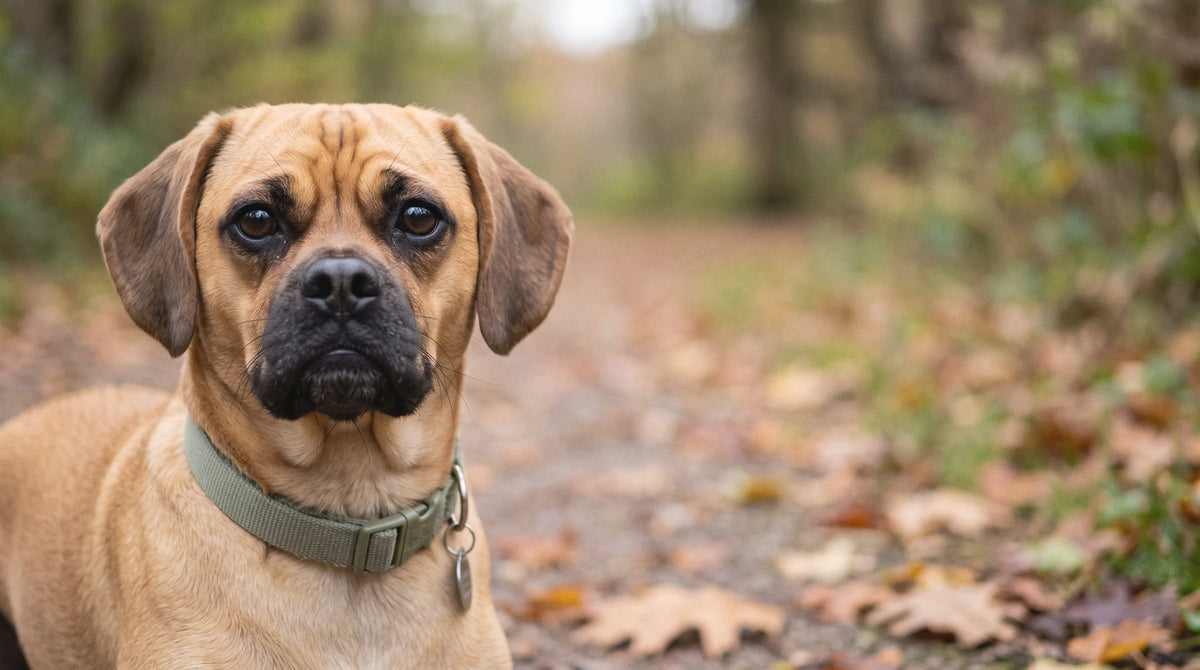
The Puggle crosses a Pug with a Beagle and weighs 14 to 30 pounds. It is small enough to be a lap dog and far too busy to spend all day being one, and its scenthound nose means it needs a leash or a fence.
- Height
- 10 to 15
- inches at the shoulder
- Weight
- 14 to 30
- pounds, adult
- Life expectancy
- 10 to 15
- years, median 12.5
- Senior from
- 9.4
- years, about
Senior starts in the last quarter of a breed's expected lifespan, following the 2019 AAHA canine life stage guidelines. Individual dogs vary.
About the breed
- Temperament
- Affectionate, outgoing, playful, sociable, intelligent, energetic
- Coat
- Smooth, short
The Puggle debuted in the United States in the 1980s as a cross between a Pug and a Beagle. The American Kennel Club does not recognise the cross or publish a standard for it, so the two parent breeds are the best guide to what to expect.
Physically, a Puggle often resembles a slightly larger Pug with longer ears, muzzle and legs, fewer wrinkles, and a Beagle's tail. Weight runs 14 to 30 pounds and height 10 to 15 inches.
The temperaments behind it are a good match. Pugs are playful and even-tempered with an outgoing, loving disposition and, despite the dignified look and a history as companions to Chinese emperors, a real sense of humour. Beagles were bred to live and work in packs as scent hounds, comfortable both alongside people and with other dogs, and capable of working alone or as part of a team.
What you get is an affectionate, outgoing family dog that needs close companionship and plenty to do. Neither parent is suited to long stretches alone, and both are prone to putting on weight when left to their own devices. The short coat needs only a weekly brush, which leaves the time free for the exercise this dog actually needs. Lifespan is 10 to 15 years.
Care
The routines that matter most for this breed. Open one at a time.
Nutrition
No two Puggles are the same, so the feeding plan is a job for your vet, built around age, size and health history rather than a chart.
Obesity is the risk that sits under everything else here. Both parent breeds are prone to putting on weight when left to their own devices, so expect the cross to be the same. Measure meals, count treats and get a target weight from your vet.
Weight matters more than usual on this dog for two separate reasons. Hip dysplasia and patellar luxation both sit in the record, and extra load makes both worse. And any degree of the Pug's flattened face means extra weight also makes breathing harder, particularly in warm weather.
A Beagle's appetite is proverbial, and a Puggle that has inherited it will make the case for food far more persuasively than the label does. Do not negotiate.
Grooming
Grooming is the easy part of owning a Puggle. The short coat needs only a weekly brushing, which leaves plenty of time for play.
The eyes need more attention than the coat. Both parent breeds are prone enough to eye problems that their official breed clubs recommend every Pug and every Beagle be examined by a board-certified veterinary ophthalmologist. A Puggle inherits from both sides of that.
From the Pug side comes the risk of proptosis, where a large protruding eye partly or fully leaves its socket, which is an emergency. From the Beagle side comes cherry eye, where the tear duct becomes inflamed and prone to infection. Watch for redness, discharge, cloudiness or a dog pawing at its face.
Check the skin and ears while you brush, since brachycephalic conformation predisposes dogs to skin and ear disease as well as to the breathing problems it is better known for.
Exercise
Puggles are far too full of energy and intelligence to spend their days lounging, whatever the lap-dog dimensions suggest. Both parents are active, intelligent breeds needing daily mental and physical stimulation, and the cross needs the same.
Use the nose. A Beagle is a scent hound and a Puggle usually inherits the equipment and the motivation, so scent games and tracking work are the most satisfying exercise you can give one and they cost no distance at all.
That same nose is the reason for a leash or a fence. A dog following a scent is not listening, and this is a cross that will keep going.
Manage the heat. A Puggle's muzzle is longer than a Pug's, but a longer muzzle does not mean the issues associated with flat-faced breeds are avoided, and heat and exercise intolerance are among them. Exercise in cooler parts of the day and stop early rather than late.
Training
Puggles are outgoing, playful dogs that enjoy the company of other dogs and of people of every age, which makes socialisation more a pleasure than a project. Both parent breeds are affectionate and gentle in families, including families with other dogs.
Train with the intelligence rather than against it. Beagles were bred to work both independently and as part of a team, so a Puggle can be self-directed without being disobedient, and interesting work holds its attention better than repetition.
Plan for company. Neither parent breed is well suited to long stretches of alone time and the offspring is no different, so the household this cross suits is one with people in it.
Choose the breeder on health. Find someone who prioritises health over profit and tests to reduce the incidence of the conditions above, several of which are inherited and none of which are cheap.
Health conditions
8 conditions are documented for the Puggle.
A predisposition is not a diagnosis. Ask your vet which screenings make sense for your dog's age.
- Autoimmune ThyroiditisHormonal
- Brachycephalic Airway SyndromeAirway & Lung
- Cherry EyeEye
- Eye ProblemsEye
- Hip DysplasiaBone & Joint
Show all 8 conditions Show fewer
- Musladin-Lueke SyndromeSkin & Connective Tissue
- ObesityMetabolic
- Patellar LuxationBone & Joint
May inherit from parent breeds
These conditions are documented in the parent breeds, not in this cross itself. Carrier possible means the condition is recessive: a dog can carry it without showing signs. Ask the breeder which tests the parent dogs had.
- AllergiesBeagle, Pug
- Bacterial pyodermaPug
- BronchiectasisBeagle
- Caudal articular process dysplasiaPug
- Cerebellar AbiotrophyCarrier possible · Beagle
Show all 38 conditions Show fewer
- Cervical ribsPug
- Cobalamin MalabsorptionBeagle
- Congenital Stationary Night BlindnessBeagle
- Degenerative MyelopathyCarrier possible · Pug
- Dental DiseasePug
- DystociaPug
- Ear InfectionsBeagle
- Factor VII DeficiencyCarrier possible · Beagle
- Heat-related illness (including heatstroke)Pug
- HemivertebraePug
- HypocatalasiaCarrier possible · Beagle
- HypothyroidismBeagle
- Idiopathic epilepsy, including epilepsy of unknown originBeagle
- Intervertebral Disc DiseaseBeagle, Pug
- Lafora disease (NHLRC1-related progressive myoclonic epilepsy)Beagle
- Legg-Calve-Perthes DiseasePug
- Lung Lobe TorsionPug
- Papillomavirus-associated cutaneous pigmented plaquesPug
- Primary Open Angle GlaucomaBeagle
- Progressive Retinal Atrophy, crd4/cord1Beagle
- Pyruvate Kinase DeficiencyCarrier possible · Beagle, Pug
- Renal agenesisBeagle
- Separation anxiety (separation distress disorder)Beagle
- Skin fold dermatitis (intertrigo)Pug
- Spina bifidaPug
- Spinal arachnoid diverticulaPug
- Stenotic NaresPug
- Steroid-responsive meningitis-arteritisBeagle
- Superficial bacterial folliculitisPug
- Systemic lupus erythematosusBeagle
- Systemic lupus erythematosus-associated polyarthritisBeagle
- Thoracolumbar transitional vertebraePug
- Thyroid carcinomaBeagle

Longevity & Vitality soft chew
Longevity & Vitality is a daily chew built on five active ingredients. Each chew carries Turkey Tail at 600mg, Curcuvet® curcumin at 75mg, Quercefit® quercetin at 40mg, Fibalance® at 275mg and EpiCor® at 50mg. The daily serving follows your dog's weight, from half a chew to three.
