
Shorkie
- Small
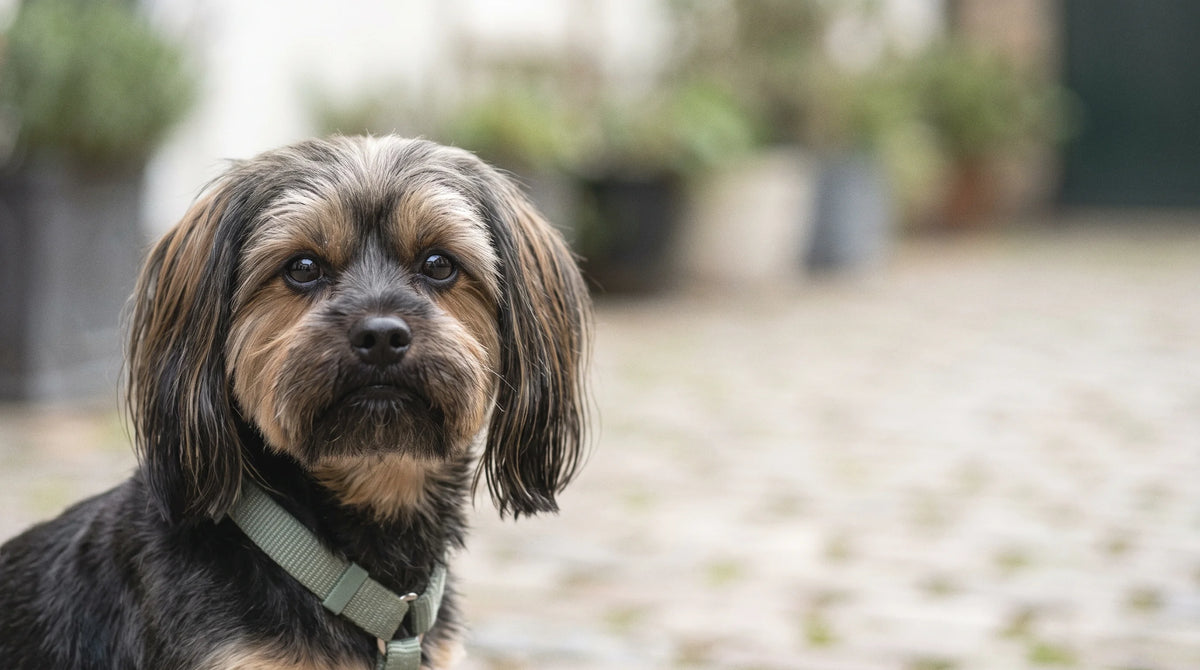
The Shorkie crosses a Shih Tzu with a Yorkshire Terrier, standing 7 to 10 inches and weighing 7 to 16 pounds. It has minimal height and maximal personality, and hair that behaves more like hair than fur.
- Height
- 7 to 10
- inches at the shoulder
- Weight
- 7 to 16
- pounds, adult
- Life expectancy
- 11 to 15
- years, median 13
- Senior from
- 9.8
- years, about
Senior starts in the last quarter of a breed's expected lifespan, following the 2019 AAHA canine life stage guidelines. Individual dogs vary.
About the breed
- Temperament
- Affectionate, sociable, confident, playful, spirited, adaptable
- Coat
- Silky, long
The Shorkie is a cross between two pint-sized breeds with luxuriously long coats, the Shih Tzu and the Yorkshire Terrier. It also answers to Shorkie Tzu and Yorkie Tzu, and it is recent enough that the American Kennel Club does not recognise it and no breed standard exists.
Both parents are well established with the AKC, though, and their standards are the blueprint. Shih Tzu spent centuries as royal pets in China, and while their name means little lion in Mandarin they are nothing like fearsome. Yorkies came out of Yorkshire, where 19th-century Scottish immigrant weavers developed them to clear rodents from the region's textile mills and mines.
What that produces is a dog of minimal height and maximal personality. Shorkies are social animals, both parents having been bred to spend their days beside people, and they want the same. They enjoy company across every age group and usually get on with other animals.
Full-grown they stand 7 to 10 inches and weigh 7 to 16 pounds, so young children and larger pets can do unintended harm and supervision is warranted. The flowing, human-like hair is the other commitment: it mats readily and takes daily work. Lifespan is 11 to 15 years.
Care
The routines that matter most for this breed. Open one at a time.
Nutrition
No general recommendation covers every Shorkie. The plan comes from your vet, built around your dog's age, weight and health, and the kibble should be small, because small teeth cannot manage large pieces.
Shorkie puppies need meals three or four times a day so their blood sugar does not fall, which is the specific hazard in a very small young dog. Adults eat less often.
Keep the dog lean. The published range spans 7 to 16 pounds, so a Shorkie at the top of it is not necessarily overweight and one at the bottom is not necessarily thin; body condition score is the useful measure and your vet can teach you to read it in a minute.
Feeding is also a trigger to know about. In a dog with tracheal collapse the honking cough worsens with eating and drinking as well as with exercise and excitement, so a new cough around meals is a symptom rather than a habit.
Grooming
Grooming a Shorkie takes more of your time than housing one takes of your space. The long, silky, human-like hair is prone to matting and needs brushing every day, with a bath at least once a month.
Treat that monthly bath as a fixed part of the schedule rather than something you do when your dog gets dirty.
Dental care is where the Shih Tzu parentage bites. Teeth easily overcrowd a small mouth, which is what makes periodontal disease so common on that side of the cross, and brushing at home at least three times a week plus professional cleanings is what holds it off.
Check the eyes while you brush. This cross can inherit cataracts, dry eye syndrome and progressive retinal atrophy from its Shih Tzu parent, so cloudiness, redness, pain, increased blinking, a mucus-like discharge or new clumsiness all deserve a call.
Exercise
Around 30 minutes of exercise a day is what a Shorkie needs, and the requirement is as much mental as physical. It will happily play the lap dog for the rest of the time.
The small stature means that half hour fits into an apartment, a house or anything between. This is a cross that adapts to the home rather than demanding one.
Use a harness rather than a collar. Both parent breeds carry an increased risk of tracheal collapse and pressure on the windpipe is one of the things that sets the cough off, along with heat, humidity, excitement and stress.
Split the time if that suits the weather or the dog. Two short outings in cool air do more for a Shorkie than one long one on a hot afternoon.
Training
Shorkies are social by descent. Both parent breeds were developed to spend their days alongside people, so training goes with the grain rather than against it as long as the work is positive and consistent.
Socialise across ages and species early. This cross typically gets on with people of all ages and with other animals, and early exposure is what turns typically into reliably.
Set the rules around children and larger dogs. At 7 to 16 pounds a Shorkie is easy to injure by accident, and the training that matters most may be the training you give everyone else in the house.
Choose the breeder carefully too. Work with someone committed to health over profit who performs genetic testing before breeding, because the liver shunts and eye conditions this cross can carry are inherited rather than acquired.
Health conditions
7 conditions are documented for the Shorkie.
A predisposition is not a diagnosis. Ask your vet which screenings make sense for your dog's age.
- CataractsEye
- Dental DiseaseOral & Dental
- Dry EyeEye
- Liver ShuntsLiver
- Patellar LuxationBone & Joint
Show all 7 conditions Show fewer
- Progressive Retinal AtrophyEye
- Tracheal CollapseAirway & Lung
May inherit from parent breeds
These conditions are documented in the parent breeds, not in this cross itself. Carrier possible means the condition is recessive: a dog can carry it without showing signs. Ask the breeder which tests the parent dogs had.
- Brachycephalic Airway SyndromeShih Tzu
- Congenital HypothyroidismCarrier possible · Shih Tzu
- CryptorchidismShih Tzu, Yorkshire Terrier
- Ear InfectionsShih Tzu
- Eye ProblemsShih Tzu
Show all 17 conditions Show fewer
- Hip DysplasiaShih Tzu
- HypoglycemiaYorkshire Terrier
- Idiopathic lymphoplasmacytic rhinitisYorkshire Terrier
- Immune-mediated polyarthritisShih Tzu
- Intervertebral Disc DiseaseShih Tzu
- ObesityShih Tzu
- Prekallikrein DeficiencyCarrier possible · Shih Tzu
- Primary Lens LuxationCarrier possible · Yorkshire Terrier
- Progressive Retinal Atrophy, prcdYorkshire Terrier
- Renal DysplasiaShih Tzu
- Tracheobronchial Collapse and BronchomalaciaYorkshire Terrier
- Urate Kidney & Bladder StonesYorkshire Terrier

Longevity & Vitality soft chew
Longevity & Vitality is a daily chew built on five active ingredients. Each chew carries Turkey Tail at 600mg, Curcuvet® curcumin at 75mg, Quercefit® quercetin at 40mg, Fibalance® at 275mg and EpiCor® at 50mg. The daily serving follows your dog's weight, from half a chew to three.
