
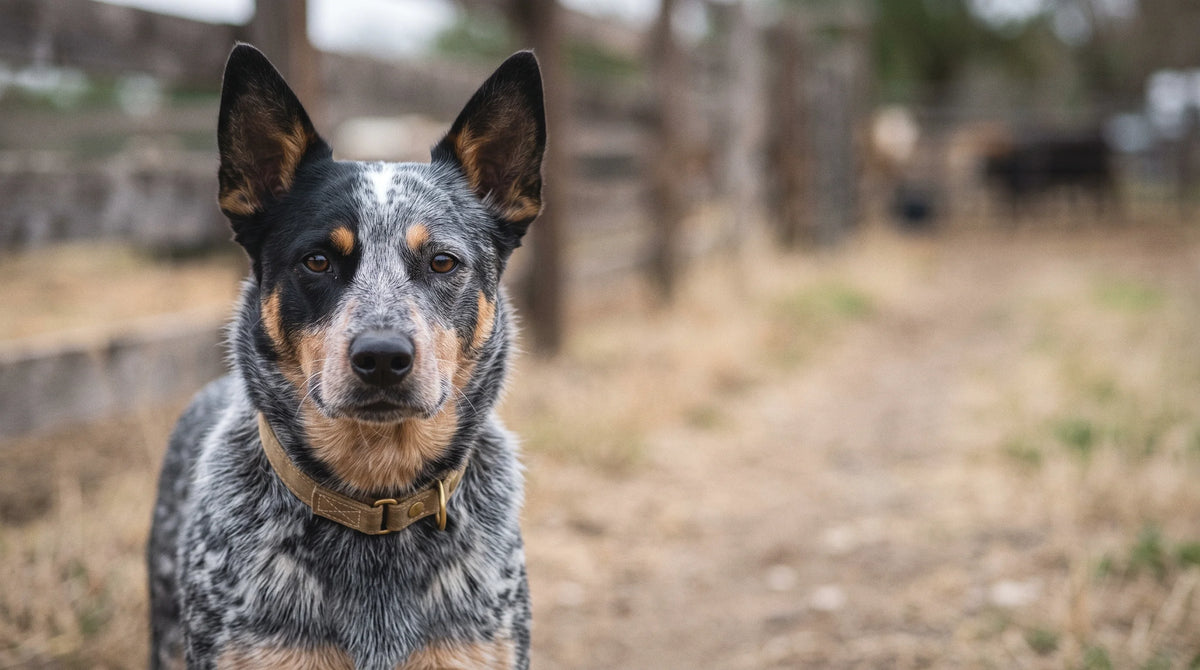
Texas Heeler
- Medium
The Texas Heeler crosses an Australian Cattle Dog with an Australian Shepherd and weighs 35 to 65 pounds. It needs a job with a physical and a mental outlet, and a ten-minute walk around the block is not one.
- Height
- 17 to 23
- inches at the shoulder
- Weight
- 35 to 65
- pounds, adult
- Life expectancy
- 12 to 16
- years, median 14
- Senior from
- 10.5
- years, about
Senior starts in the last quarter of a breed's expected lifespan, following the 2019 AAHA canine life stage guidelines. Individual dogs vary.
About the breed
- Temperament
- Athletic, intelligent, energetic, loyal, devoted, alert
- Coat
- Double, medium
- Origin
- United States
First bred in Texas, the Texas Heeler is a cross between the Australian Cattle Dog and the Australian Shepherd. Little is known for certain about its recent beginnings and the American Kennel Club does not recognise it, so the parent standards do the predicting.
Australian Cattle Dogs descend from the dingo and were bred to move cattle in open and confined spaces. Their standard calls them always alert, extremely intelligent, watchful, courageous and trustworthy, with an implicit devotion to duty. Australian Shepherds are working dogs too, developed in the United States, described by their standard as intelligent and active with an even disposition and the stamina to work all day.
The result is an athletic medium-size dog of 35 to 65 pounds with Texas-size levels of intelligence and energy. The coat runs short to medium in black, blue, brown, fawn and grey combinations, ears tend to be upright like the Cattle Dog's, and some are born with the Aussie's bobbed tail.
Temperament is constant companion rather than aloof worker. Texas Heelers are loyal, loving and devoted to their family, and they are happy to go wherever you are going, though they can be wary of strangers. Lifespan is 12 to 16 years.
Care
The routines that matter most for this breed. Open one at a time.
Nutrition
Feed a Texas Heeler as the working dog it is. This is an athletic animal with a genuine daily workload, and the diet should be matched to that as well as to age and weight, which is a conversation for your vet.
Keep the dog lean and well-muscled rather than merely light. Hip and elbow dysplasia both run in this cross and both are worsened by carrying weight, and a working dog that is under-conditioned is as vulnerable as one that is overfed.
Schedule meals around exercise, not right before it. A dog doing daily sport benefits from a predictable schedule with a gap either side of hard work.
Long-lived dogs need the diet to move with them. At 12 to 16 years this cross will spend several years as a senior, and the food should change when your vet says the dog has.
Grooming
As you would expect from a dog designed for outdoor work, the Texas Heeler is low maintenance at the brush. The double coat needs going over once a week.
Twice a year that changes. The undercoat sheds out and the coat needs extra attention for a few weeks, which is a seasonal job rather than a permanent one.
Use the weekly session to check the ears properly. Congenital deafness affects both parent breeds and can involve one ear or both, and a BAER test is what confirms it. Nothing reverses it, but a deaf dog trained with hand signals lives an entirely normal life, and knowing early is what makes that straightforward.
Check the eyes as well. Both parents are prone enough to eye problems that their breed clubs recommend an examination by a board-certified veterinary ophthalmologist before breeding, and progressive retinal atrophy and hereditary cataracts both appear in this cross.
Exercise
A Texas Heeler needs a job, and that is the single most important thing about owning one. These dogs will not be content with a ten-minute daily walk around the block.
What works instead is real work or real sport. A farm is the obvious answer and most people do not have one, so the practical version is daily running, agility or obedience training, done properly rather than fitted in.
No figure in minutes is published for the cross. The nearest real number comes from the Australian Cattle Dog parent, whose activity list specifies running or jogging daily for at least 45 minutes, and that is a floor rather than a target for a dog with two working parents.
The mental half is not separable. An intelligent herding cross with a tired body and an unoccupied mind will invent a job, and it will not be the one you wanted.
Training
Two working parents with implicit devotion to duty produce a dog that wants to be told what to do. Training a Texas Heeler is less about compliance than about supplying enough structure to absorb the intelligence.
Socialise early against the wariness. These dogs are devoted to their own family and can be wary of strangers, and calm, repeated early exposure is what keeps that from hardening.
Channel the herding drive deliberately. Obedience and agility give the instinct a shape, and a dog with an outlet is far less likely to apply the instinct to children, cats or cyclists.
Choose the breeder on health. Work with someone committed to health over profit who performs genetic testing before breeding, since deafness and the eye conditions here are congenital rather than acquired.
Health conditions
5 conditions are documented for the Texas Heeler.
A predisposition is not a diagnosis. Ask your vet which screenings make sense for your dog's age.
- CataractsEye
- DeafnessEar & Hearing
- Elbow DysplasiaBone & Joint
- Hip DysplasiaBone & Joint
- Progressive Retinal AtrophyEye
May inherit from parent breeds
These conditions are documented in the parent breeds, not in this cross itself. Carrier possible means the condition is recessive: a dog can carry it without showing signs. Ask the breeder which tests the parent dogs had.
- Canine Multifocal Retinopathy, cmr1Australian Shepherd
- Collie Eye AnomalyCarrier possible · Australian Shepherd
- CystinuriaAustralian Cattle Dog
- Degenerative MyelopathyCarrier possible · Australian Shepherd
- Eye ProblemsAustralian Cattle Dog
Show all 20 conditions Show fewer
- HemangiosarcomaAustralian Shepherd
- Hereditary Cerebellar AtaxiaAustralian Shepherd
- Hip and Elbow DysplasiaAustralian Shepherd
- Idiopathic epilepsy, including epilepsy of unknown originAustralian Shepherd
- Iris ColobomaAustralian Shepherd
- Joint ProblemsAustralian Cattle Dog
- Junctional Epidermolysis BullosaAustralian Shepherd
- Late-Onset Neuronal Ceroid LipofuscinosisAustralian Cattle Dog
- LymphomaAustralian Shepherd
- MDR1 Drug SensitivityAustralian Cattle Dog, Australian Shepherd
- Neuronal Ceroid Lipofuscinosis 5Carrier possible · Australian Cattle Dog
- Neuronal Ceroid Lipofuscinosis 8Carrier possible · Australian Shepherd
- Primary Lens LuxationCarrier possible · Australian Cattle Dog
- Progressive Retinal Atrophy, prcdAustralian Cattle Dog, Australian Shepherd
- Urate Kidney & Bladder StonesCarrier possible · Australian Shepherd

Longevity & Vitality soft chew
Longevity & Vitality is a daily chew built on five active ingredients. Each chew carries Turkey Tail at 600mg, Curcuvet® curcumin at 75mg, Quercefit® quercetin at 40mg, Fibalance® at 275mg and EpiCor® at 50mg. The daily serving follows your dog's weight, from half a chew to three.
