
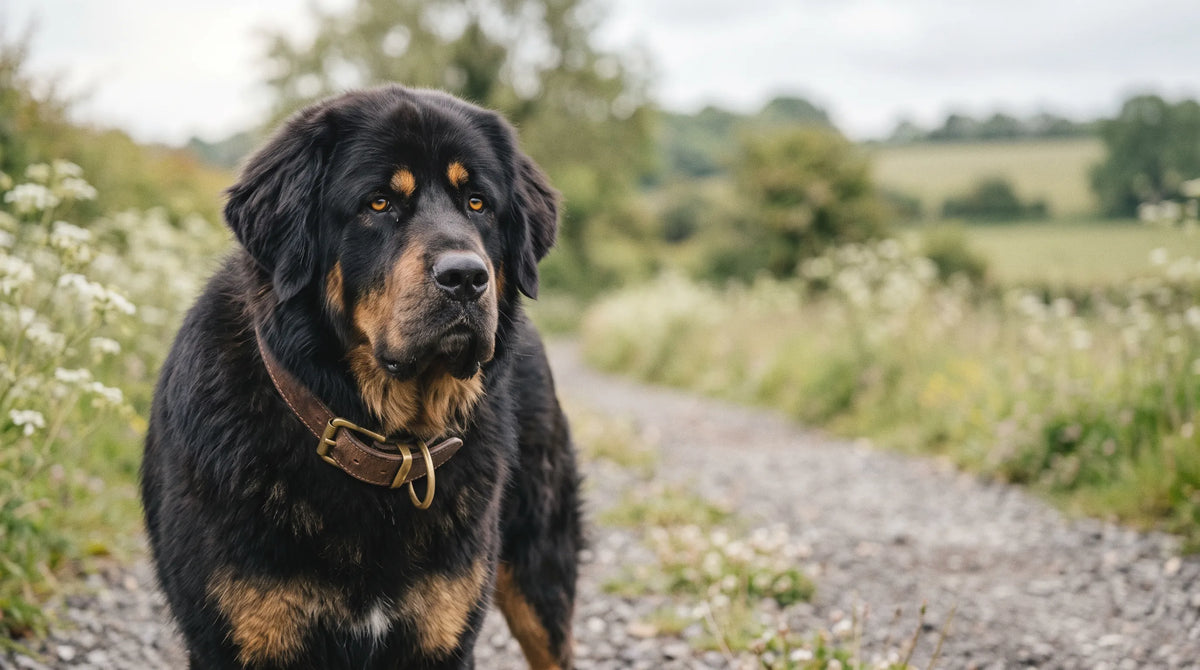
Tibetan Mastiff
- Giant
- Working Group
- Popularity rank 142
The Tibetan Mastiff is an ancient guardian from Tibet, giant in size yet surprisingly light on its feet. Reserved, independent, and intelligent, this watchful dog meets a perceived threat with quiet agility.
- Height
- 24 to 26
- inches at the shoulder
- Weight
- 70 to 150
- pounds, adult
- Life expectancy
- 10 to 12
- years, median 11
- Senior from
- 8.2
- years, about
Senior starts in the last quarter of a breed's expected lifespan, following the 2019 AAHA canine life stage guidelines. Individual dogs vary.
About the breed
- Temperament
- Reserved, independent, intelligent
- Coat
- Double, medium
- Origin
- Tibet
- Recognized
- 2006
2015: rank 133, 2016: rank 135, 2017: rank 153, 2018: rank 131, 2019: rank 130, 2020: rank 140, 2021: rank 147, 2022: rank 137, 2023: rank 143, 2024: rank 148, 2025: rank 142
The Tibetan Mastiff is an ancient guardian breed, and one look is often enough to send an intruder looking for easier targets. It is hard to describe without words like muscular, massive, and substantial, standing up to 26 inches at the shoulder and weighing well over 100 pounds (typically 70 to 150). For all that bulk, it is also light on its feet and can meet a perceived threat with surprising agility.
The broad head carries high-set, V-shaped ears and expressive brown eyes, together projecting a noble, watchful expression. Reserved, independent, and intelligent by nature, this is a dog that thinks for itself.
Originally from Tibet, the breed belongs to the Working Group and was recognized by the registry in 2006.
Temperament and needs
Scored 1 to 5 for the breed overall. Individual dogs vary.
- Affectionate with family4 out of 5
- Good with young children3 out of 5
- Good with other dogs3 out of 5
- Openness to strangers1 out of 5
- Playfulness3 out of 5
- Watchdog and protective nature5 out of 5
- Adaptability3 out of 5
- Trainability3 out of 5
- Energy level3 out of 5
- Mental stimulation needs4 out of 5
- Barking level3 out of 5
- Shedding4 out of 5
- Grooming frequency3 out of 5
- Drooling3 out of 5
Care
The routines that matter most for this breed. Open one at a time.
Nutrition
The Tibetan Mastiff does well on a high-quality dog food, whether commercially made or home-prepared with your veterinarian's supervision and approval. Match the diet to the dog's life stage, whether puppy, adult, or senior, and keep clean, fresh water available at all times. This breed needs no special diet.
Tibetan Mastiffs eat far less than their size suggests. Adults may need only two to four cups a day, fed twice, morning and evening, with the amount based on an ideal adult weight of roughly 70 to 150 pounds. They tend to eat only when hungry, and skipping a meal is common; when females are in season, males often refuse food for a week or more and can lose 10 to 15 percent of their body weight.
Your food package carries a feeding guideline, and your veterinarian can help set the right daily amount and address any weight or diet concerns. Learn which human foods are safe for dogs and which are not.
To support joint and skin health, you can add supplements such as glucosamine and omega-3 fish oil to meals. Some commercial joint-health dog foods already include added omega-3 or glucosamine.
Grooming
The Tibetan Mastiff is double coated, with a heavy, wooly undercoat and coarse guard hair. For most of the year the coat is low-maintenance: a weekly brushing with a slicker or long pin brush removes surface dirt, and a wide-tooth comb works through tangles on the tail, mane, and breeches. The breed standard calls for the dog to be shown as it grows, with no clipping or trimming except to shape the feet and clean up the hocks.
Once a year, in late spring or summer, Tibetan Mastiffs blow their undercoat in a heavy shed. During this stretch they need almost daily grooming with an undercoat rake or deshedding tool to clear the loose hair. The rest of the year, the weekly brushing is enough.
Regular bathing is not required unless your dog rolls in something foul or gets very dirty outdoors. After a bath, dry the coat with a large towel or a hair dryer on low heat, since the thick coat can otherwise trap moisture against the skin.
Add nail trims and tooth brushing to the routine. After every bath, swim, or roll in the yard, clean the ears with a dog-specific ear cleaner so trapped moisture does not build up, and have the eyes examined at least once a year by a veterinarian.
Exercise
Tibetan Mastiffs need daily moderate exercise, and it does not have to be organized activity. They favor work-related tasks like patrolling their territory over structured play such as fetch or chasing a disc. The breed conserves energy until it is needed, showing short bursts of activity rather than endurance, and is more active in cooler weather, preferring a short, brisk walk to a long, slow stroll.
Given their size and athletic build, they need room to move and do not suit apartment life. A large, fenced yard to patrol is ideal, and the fencing matters: a Tibetan Mastiff will roam. A dog that feels confined or bored may turn destructive and anxious, digging and chewing. One living in an apartment in a hot area will not do nearly as well as one on a large, fenced property in a cold climate.
The breed needs ample living space, early socialization, and a budget for food and care. Pet insurance may help cover medical costs.
Training
Tibetan Mastiffs do not respond well to traditional obedience training. They are highly intelligent and learn quickly, but they see no need to repeat what they already know, and they tend to choose instinct over a command when in doubt. They are known for performing well in class and then ignoring those same commands once back home, and they bore as fast as they learn.
This breed is not food driven, so treats are not a reliable training tool. Use positive reinforcement and reward-based methods, with patience and persistence. Recall is unreliable even in well-trained dogs, so never let a Tibetan Mastiff off leash in unsecured areas. The breed is clean and generally easy to housebreak.
Aloof, watchful, and alert, the Tibetan Mastiff can make a loyal family dog. That loyalty makes them reserved around strangers, so introductions need care. Socialize puppies well with people and other pets so they grow more accepting of new faces.
They can be lazy indoors and sleep through the day, then turn more active at night. They are fairly quiet but will bark to alert the family when something seems off.
Health conditions
3 conditions are documented for the Tibetan Mastiff.
A predisposition is not a diagnosis. Ask your vet which screenings make sense for your dog's age.
- Eye ProblemsEye
- Hip and Elbow DysplasiaBone & Joint
- HypothyroidismHormonal


Sources
Thank you. Your report is in, and we will check this page.
Longevity & Vitality soft chew
Longevity & Vitality is a daily chew built on five active ingredients. Each chew carries Turkey Tail at 600mg, Curcuvet® curcumin at 75mg, Quercefit® quercetin at 40mg, Fibalance® at 275mg and EpiCor® at 50mg. The daily serving follows your dog's weight, from half a chew to three.
