
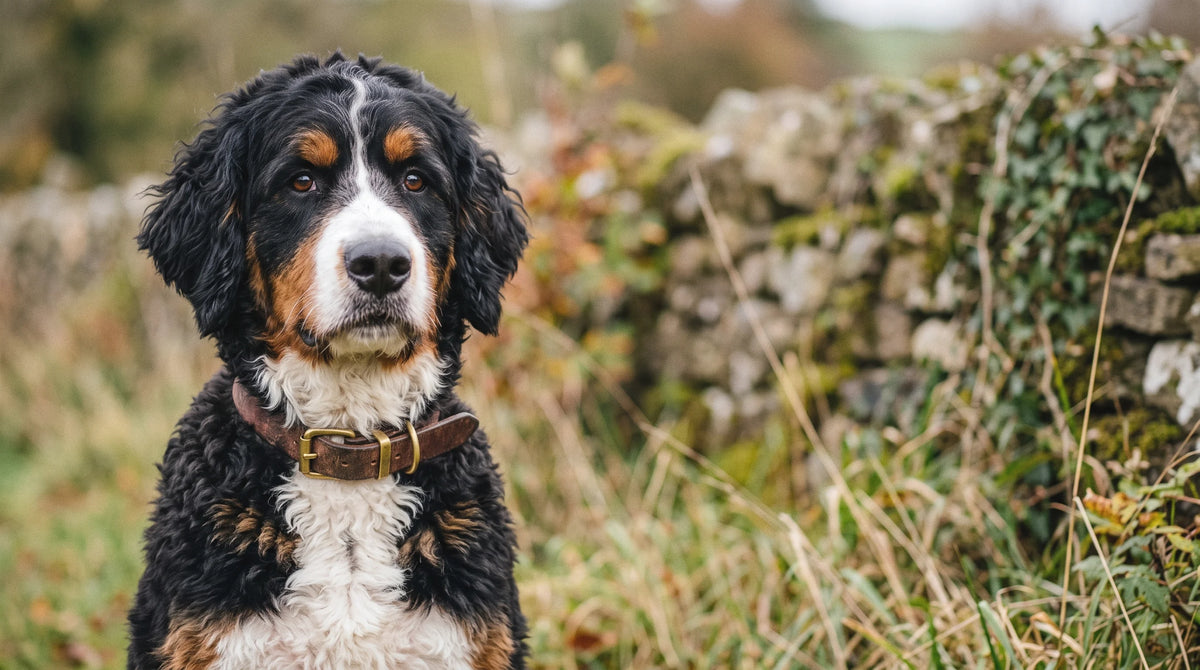
Standard Bernedoodle
- Large
The Standard is the largest of the three Bernedoodle size tiers PetMD describes, reaching 29 inches and 61 to 100 pounds. It is a gentle, goofy dog, and its deep chest changes how it should be fed and exercised.
- Height
- ≤29
- inches at the shoulder
- Weight
- 61 to 100
- pounds, adult
- Life expectancy
- 12 to 15
- years, median 13.5
- Senior from
- 10.1
- years, about
Senior starts in the last quarter of a breed's expected lifespan, following the 2019 AAHA canine life stage guidelines. Individual dogs vary.
About the breed
- Temperament
- Playful, gentle, outgoing, affectionate, intelligent, calm
- Coat
- Curly, Wavy, medium
The Standard Bernedoodle is the full-sized version of the Bernese Mountain Dog and Poodle cross: 61 to 100 pounds, standing up to 29 inches. Lifespan is 12 to 15 years, the shortest of the three tiers, which is the usual pattern in dogs where size and longevity trade against each other.
Size changes the practicalities rather than the character. A Standard prefers more space to stretch out and to sleep than the smaller tiers do, and it will take a lot more exercise, but the temperament is the same: fun-loving, outgoing, goofy, playful and gentle, good with children and other animals, and quiet unless surprised.
The deep chest is the one thing that genuinely marks this tier out medically. Large deep-chested dogs are at risk of gastric dilatation-volvulus, a severe and fast-moving form of bloat, and that risk shapes how a Standard Bernedoodle should be fed and exercised rather than being a footnote.
The coat is low-shedding, low-allergen and a serious job at this scale, and how much a given dog sheds depends on whether it takes after the Bernese side. No dog is genuinely hypoallergenic.
Care
The routines that matter most for this breed. Open one at a time.
Nutrition
Look for an Association of American Feed Control Officials (AAFCO) nutritional adequacy statement on the label, and for a Standard Bernedoodle puppy specifically a formula made for large breeds, which controls the growth rate rather than just the calories.
Puppies eat three to four meals a day on a regular schedule; adults eat two. Twelve-hour intervals are better than one big daily meal for the metabolism and for the dog's head, and at this size there is a further reason: smaller, more frequent meals mean the dog eats less at a sitting and usually more slowly, which lowers the risk of gastric dilatation-volvulus.
Bloat is the emergency to know. It happens fast in dogs that eat too quickly or take the whole day's food in one go. Watch for an inability to settle, retching, a distended abdomen, heavy drooling, or the dog stretching into a downward-dog or praying-mantis position, and go to an emergency vet immediately rather than waiting it out. A slow feeder is worth using from day one.
Keep the dog lean, because weight loads the hips and elbows directly. Supplements are unnecessary on a balanced diet, though joint supplements come up often in this tier; ask your vet.
Grooming
A Standard Bernedoodle carries a lot of coat, and the honest description of the grooming is that this is not a low-maintenance breed. Weekly brushing at minimum, plus regular professional grooming to keep the coat tangle-free and stop it growing out of control.
Shedding varies with which parent the dog favours. One that takes after the Bernese Mountain Dog sheds noticeably more than one that takes after the Poodle, and neither is a grooming holiday.
Bathe when the dog is genuinely dirty, which for an outdoorsy 80-pound animal is fairly often, but keep it to once a month at most or the skin dries out. Brush the teeth daily.
Eyes need only that the hair around them is not obstructing vision or causing irritation; report cloudiness, redness or discharge. Ears need cleaning after every swim without exception, since a big drop ear that stays damp is an ear infection waiting to happen.
Exercise
Plan on at least two walks a day, and expect a Standard Bernedoodle to want more ground than either smaller tier. This is a dog that is equally happy on the couch and tearing round a yard, and the second is what makes the first pleasant.
Time exercise away from meals. In a deep-chested dog, hard activity too close to eating is one of the things associated with bloat, so the run goes before breakfast or well after it.
Hiking, running, swimming, agility and obstacle courses all suit the breed. Go easy on repeated hard jumping while the dog is growing, since hip and elbow dysplasia are the conditions this cross actually carries and joint load in a fast-growing large puppy is worth managing.
Mental work is part of the requirement, not a substitute for the walk. Games, snuffle mats and puzzle toys are what keep a clever large dog from inventing its own projects.
Training
A Standard Bernedoodle is intelligent and happy to please, and picks up basic cues, tricks, crate training and house training readily on positive reinforcement. At this size an untrained dog is a much bigger problem, so do not skip it.
Start leash training immediately. A dog that loves walks and will grow to 100 pounds needs to learn how to walk before it can pull, not after.
Early and consistent training, from a well-bred puppy, is what produces the gentle adult the breed is famous for. The Bernese half brings the gentleness and the Poodle half brings the speed of learning; neither substitutes for the schedule.
Socialisation is straightforward here. Standard Bernedoodles love being around children, romp happily with other dogs and are gentle with cats, so the work is exposure rather than damage control. Get the manners in while the dog is still liftable.
Health conditions
4 conditions are documented for the Standard Bernedoodle.
A predisposition is not a diagnosis. Ask your vet which screenings make sense for your dog's age.
- Bloat (Gastric Dilatation-Volvulus)Digestive
- Elbow DysplasiaBone & Joint
- Hip DysplasiaBone & Joint
- Progressive Retinal AtrophyEye
May inherit from parent breeds
These conditions are documented in the parent breeds, not in this cross itself. Carrier possible means the condition is recessive: a dog can carry it without showing signs. Ask the breeder which tests the parent dogs had.
- Addison's DiseaseMiniature Poodle, Standard Poodle, Toy Poodle
- BronchiectasisMiniature Poodle, Standard Poodle, Toy Poodle
- CancerBernese Mountain Dog
- Chronic BronchitisMiniature Poodle, Standard Poodle, Toy Poodle
- CryptorchidismMiniature Poodle, Standard Poodle, Toy Poodle
Show all 25 conditions Show fewer
- Degenerative MyelopathyCarrier possible · Bernese Mountain Dog
- DystociaMiniature Poodle, Standard Poodle, Toy Poodle
- Ectopic UreterMiniature Poodle, Standard Poodle, Toy Poodle
- Familial membranoproliferative glomerulonephritisBernese Mountain Dog
- Geriatric-onset laryngeal paralysis polyneuropathy, GOLPPMiniature Poodle, Standard Poodle, Toy Poodle
- HypothyroidismMiniature Poodle, Standard Poodle, Toy Poodle
- Idiopathic epilepsy, including epilepsy of unknown originBernese Mountain Dog, Miniature Poodle, Standard Poodle, Toy Poodle
- Immune-mediated polyarthritisBernese Mountain Dog
- Immune-mediated thrombocytopeniaMiniature Poodle, Standard Poodle, Toy Poodle
- Intervertebral Disc DiseaseMiniature Poodle, Standard Poodle, Toy Poodle
- Noise aversion (noise sensitivity; noise phobia when clinically diagnosed)Miniature Poodle, Standard Poodle, Toy Poodle
- OsteoarthritisBernese Mountain Dog
- Puerperal hypocalcemia (eclampsia)Miniature Poodle, Standard Poodle, Toy Poodle
- PyometraBernese Mountain Dog
- Steroid-responsive meningitis-arteritisBernese Mountain Dog
- Systemic lupus erythematosusMiniature Poodle, Standard Poodle, Toy Poodle
- Systemic lupus erythematosus-associated polyarthritisMiniature Poodle, Standard Poodle, Toy Poodle
- Tracheal CollapseMiniature Poodle, Standard Poodle, Toy Poodle
- Tracheobronchial Collapse and BronchomalaciaMiniature Poodle, Standard Poodle, Toy Poodle
- Von Willebrand Disease Type ICarrier possible · Bernese Mountain Dog

Longevity & Vitality soft chew
Longevity & Vitality is a daily chew built on five active ingredients. Each chew carries Turkey Tail at 600mg, Curcuvet® curcumin at 75mg, Quercefit® quercetin at 40mg, Fibalance® at 275mg and EpiCor® at 50mg. The daily serving follows your dog's weight, from half a chew to three.
