
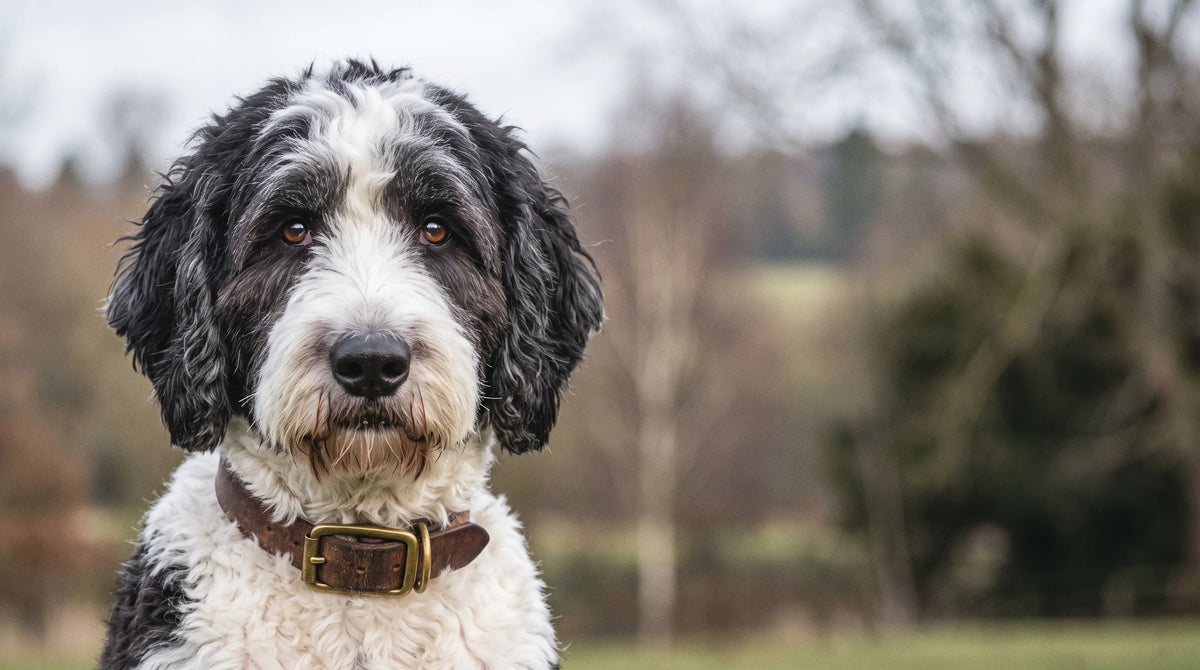
Sheepadoodle
- Large
The Sheepadoodle crosses an Old English Sheepdog with a Poodle and weighs 65 to 85 pounds. It is fluffy, clever and sweet-natured, and it may well shed, since only the Poodle side of the cross does not.
- Height
- 16 to 22
- inches at the shoulder
- Weight
- 65 to 85
- pounds, adult
- Life expectancy
- 12 to 15
- years, median 13.5
- Senior from
- 10.1
- years, about
Senior starts in the last quarter of a breed's expected lifespan, following the 2019 AAHA canine life stage guidelines. Individual dogs vary.
About the breed
- Temperament
- Affectionate, intelligent, playful, adaptable, easygoing, energetic
- Coat
- Curly, Wavy, long
Sheepadoodles are a crossbreed of Old English Sheepdogs and Poodles, most often black and white, and usually on the larger side at 65 to 85 pounds. They are less common than the Goldendoodle but growing in popularity as family pets, and increasingly as therapy dogs and emotional support animals.
The temperament people choose them for is real. A well-bred Sheepadoodle is adaptable, intelligent, affectionate and playful, with the easygoing, good-natured character of the Old English Sheepdog side.
It also has to be the right family. Both parent breeds are intelligent and need mental stimulation to avoid developing behaviour problems, and one veterinarian familiar with the cross recommends it for families who actively want a dog that requires a lot of time and attention. Take that as a description of the commitment, not a warning.
One expectation worth correcting up front. Poodles are considered not to shed and Old English Sheepdogs do shed, so a Sheepadoodle cannot be assumed to be a non-shedder. Both parent breeds also carry significant grooming requirements, whichever coat your dog ends up with. Lifespan is 12 to 15 years.
Care
The routines that matter most for this breed. Open one at a time.
Nutrition
Choose the food for size and activity, and start a Sheepadoodle puppy on a large-breed puppy formula. Large-breed puppies grow bone more slowly than small ones, and the right nutrition during that window is how bone health is protected. Move to a food for the appropriate life stage as the dog grows.
Feed an adult twice a day, and a puppy on three or four mealtimes before switching.
Bloat shapes the mealtime routine here. For a dog at high risk of gastric dilatation-volvulus, split the day's food across several small meals rather than one large one, restrict exercise before and after eating, keep mealtimes calm and low-stress, and do not use an elevated bowl. Severe bloat progresses to GDV, which is fatal untreated, and a gastropexy performed during a spay or neuter is one preventive option worth discussing.
Do not overfeed. A large breed can still become overweight, and the feeding guide on a food that meets the Association of American Feed Control Officials (AAFCO) profiles, plus regular attention to body condition, is the way to keep it honest. Count treats in the daily total. Because both parents are prone to hip dysplasia, ask your vet whether a joint supplement makes sense for your dog.
Grooming
Both parent breeds have significant grooming requirements, so there is no version of this dog that is low effort. The fluffy coat is the single largest ongoing job in owning one.
Set expectations about shedding before you commit. Poodles are considered not to shed, Old English Sheepdogs do, and a Sheepadoodle can land anywhere between, so nobody can promise you a coat that stays off the furniture.
Watch the eyes closely, because this is a cross where both parents carry substantial lists of inherited eye problems and those lists overlap heavily. Cataracts, corneal dystrophy, distichiasis and progressive retinal atrophy all appear on both sides.
Congenital and inherited eye conditions tend to be breed-related rather than random, which is a reason to ask a breeder specifically about eye testing in the parents rather than accepting a general assurance of health.
Exercise
This is an active dog that needs a lot of time and attention, and the family that suits it is one that wants that rather than tolerates it. A Sheepadoodle left short of both is where the behaviour problems come from.
Two intelligent parent breeds means the mental half is not optional. Training sessions, puzzles and work that asks the dog to think count toward the day as much as the walk does.
Keep hard exercise away from meals. In a large, deep-chested dog that is a bloat precaution with a specific instruction behind it: restrict activity before and after eating.
The endurance is the notable thing rather than raw speed. A Sheepadoodle will keep going for a long walk or a long afternoon, which makes it a good companion for people who are already outdoors and a poor one for people who are not.
Training
A Sheepadoodle is bred to combine what people like about both parents, and what that produces is a clever, playful, loving dog that wants a job. Training is the job.
Start early and keep going. Both parent breeds need mental stimulation to avoid developing behavioural issues, which means training is preventive rather than corrective in this cross, and it works best as a lifelong habit rather than a puppy course.
Use the temperament. The easygoing, good-natured character the Old English Sheepdog side brings is what makes these dogs work as therapy animals and emotional support dogs, and it responds to patient, positive handling.
Be honest with yourself about the time. They suit families who want an active dog that needs a lot of attention. If that is not your household, make sure you have the time before bringing one home.
Health conditions
6 conditions are documented for the Sheepadoodle.
A predisposition is not a diagnosis. Ask your vet which screenings make sense for your dog's age.
- Bloat (Gastric Dilatation-Volvulus)Digestive
- CataractsEye
- Corneal DystrophyEye
- DistichiasisEye
- Hip DysplasiaBone & Joint
Show all 6 conditions Show fewer
May inherit from parent breeds
These conditions are documented in the parent breeds, not in this cross itself. Carrier possible means the condition is recessive: a dog can carry it without showing signs. Ask the breeder which tests the parent dogs had.
- Addison's DiseaseStandard Poodle
- Autoimmune ThyroiditisOld English Sheepdog
- BronchiectasisStandard Poodle
- Carcinoma of the nasal cavity and paranasal sinusesOld English Sheepdog
- Cerebellar AbiotrophyOld English Sheepdog
Show all 30 conditions Show fewer
- Chronic BronchitisStandard Poodle
- CryptorchidismStandard Poodle
- DeafnessOld English Sheepdog
- Dilated CardiomyopathyOld English Sheepdog
- DystociaStandard Poodle
- Ectopic UreterStandard Poodle
- Exercise-Induced CollapseCarrier possible · Old English Sheepdog
- Geriatric-onset laryngeal paralysis polyneuropathy, GOLPPStandard Poodle
- Hereditary Cerebellar AtaxiaOld English Sheepdog
- HypothyroidismStandard Poodle
- Idiopathic epilepsy, including epilepsy of unknown originStandard Poodle
- Immune-mediated thrombocytopeniaOld English Sheepdog, Standard Poodle
- Intervertebral Disc DiseaseStandard Poodle
- MDR1 Drug SensitivityOld English Sheepdog
- Noise aversion (noise sensitivity; noise phobia when clinically diagnosed)Standard Poodle
- OsteoarthritisOld English Sheepdog
- Primary Ciliary DyskinesiaCarrier possible · Old English Sheepdog
- Puerperal hypocalcemia (eclampsia)Standard Poodle
- Skin IssuesStandard Poodle
- Systemic lupus erythematosusOld English Sheepdog, Standard Poodle
- Systemic lupus erythematosus-associated polyarthritisStandard Poodle
- Tracheal CollapseStandard Poodle
- Tracheobronchial Collapse and BronchomalaciaStandard Poodle
- Urethral Sphincter Mechanism IncompetenceOld English Sheepdog
- Von Willebrand DiseaseStandard Poodle

Longevity & Vitality soft chew
Longevity & Vitality is a daily chew built on five active ingredients. Each chew carries Turkey Tail at 600mg, Curcuvet® curcumin at 75mg, Quercefit® quercetin at 40mg, Fibalance® at 275mg and EpiCor® at 50mg. The daily serving follows your dog's weight, from half a chew to three.
