
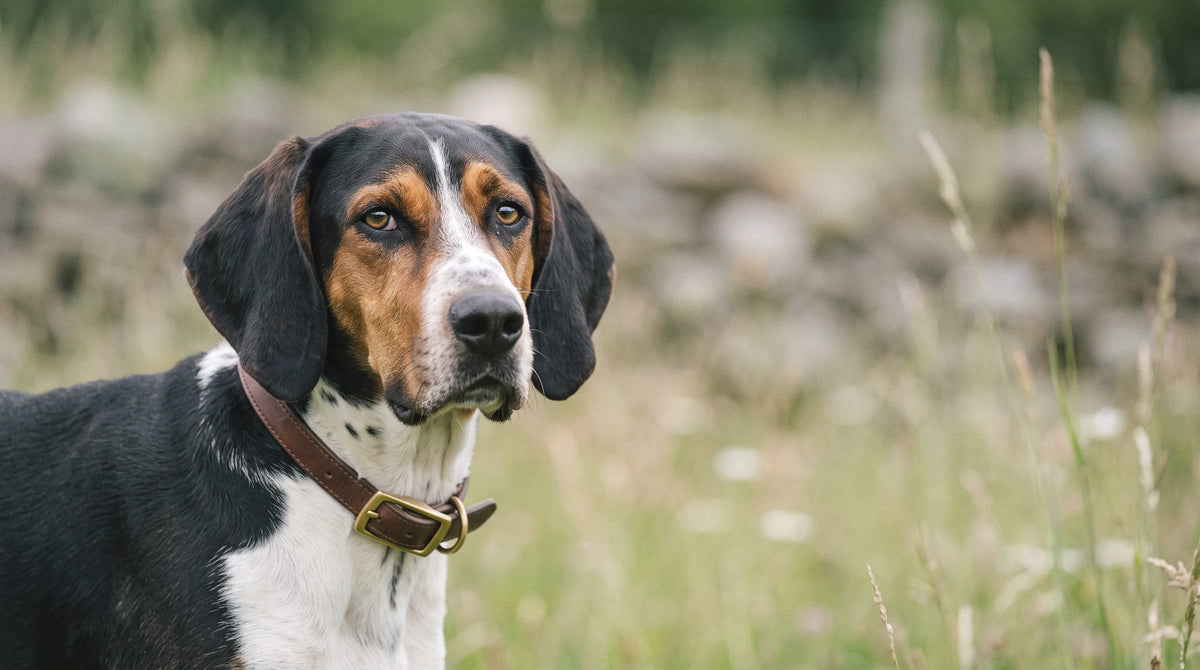
American English Coonhound
- Large
- Hound Group
- Popularity rank 182
The American English Coonhound is a sweet, mellow hound with a powerful nose and a ringing bark. Bred to trail raccoons across rough country, this sociable athlete thrives with an active family and room to run.
- Height
- 23 to 26
- inches at the shoulder
- Weight
- 45 to 65
- pounds, adult
- Life expectancy
- 11 to 12
- years, median 11.5
- Senior from
- 8.6
- years, about
Senior starts in the last quarter of a breed's expected lifespan, following the 2019 AAHA canine life stage guidelines. Individual dogs vary.
About the breed
- Temperament
- Sociable, sweet, mellow
- Coat
- Smooth, short
- Origin
- United States
- Recognized
- 2011
2015: rank 166, 2016: rank 170, 2017: rank 178, 2018: rank 175, 2019: rank 177, 2020: rank 185, 2021: rank 184, 2022: rank 182, 2023: rank 178, 2024: rank 171, 2025: rank 182
The American English Coonhound is a deep-chested, athletic scenthound standing 23 to 26 inches at the shoulder and weighing 45 to 65 pounds. The short, smooth coat lies tight across the frame in patterns that often include red, white, blue, and tricolor, sometimes with ticking. The head is broad with a domed skull, soft low-hung ears, and dark-brown eyes.
Also called the Redtick Coonhound, the breed descends from European hunting dogs brought to the United States and refined for tracking raccoons and other game. It earned formal recognition in 2011 and is valued by hunters for its speed, stamina, and distinctive baying voice.
Off duty these hounds are mellow and affectionate, bonding closely with their family and generally getting along with strangers and other dogs when properly socialized. On the trail they turn tenacious and single-minded. They carry a strong prey drive, so small animals like rabbits and cats can be tempting to chase, and a securely fenced space or leash keeps everyone safe.
The work drive, the patience training demands, and the loud, ringing bark can make this a poor fit for first-time owners. The breed is loyal and can suit an active home that provides a sporting outlet.
Temperament and needs
Scored 1 to 5 for the breed overall. Individual dogs vary.
- Affectionate with family3 out of 5
- Good with young children3 out of 5
- Good with other dogs5 out of 5
- Openness to strangers3 out of 5
- Playfulness3 out of 5
- Watchdog and protective nature3 out of 5
- Adaptability3 out of 5
- Trainability3 out of 5
- Energy level4 out of 5
- Mental stimulation needs3 out of 5
- Barking level4 out of 5
- Shedding2 out of 5
- Grooming frequency1 out of 5
- Drooling1 out of 5
Care
The routines that matter most for this breed. Open one at a time.
Nutrition
Match the diet to the dog's life stage, puppy, adult, or senior, and to its activity level, since a working dog needs very different food from one that lives a more sedentary life. Keep clean, fresh water available at all times.
Coonhounds are prone to gaining weight as they age, so be mindful of calorie intake. Treats help with training, but too many add up, so monitor the total food and treats you give.
Feed an adult twice daily, morning and evening. Puppies need three to four smaller meals a day. Because this is a deep-chested breed, take steps to guard against bloat and GDV:
- Offer smaller, more frequent meals instead of one large daily meal
- Use slow-feeder bowls so they eat slowly
- Avoid raised food bowls
- Limit exercise directly before or after eating
- Ask your vet whether a gastropexy, which secures the stomach against twisting, is right for your dog
Feeding amounts vary by age, weight, activity level, and life stage. Use the guidelines on the dog food packaging as a starting point, and ask your vet for more specific guidance.
Supplements can support your Coonhound's overall health. Glucosamine and chondroitin support healthy joints, omega-3 fatty acids support a shiny coat, and antioxidants such as vitamins C and E support immunity. Always talk to your vet to determine the right supplements and dosages, and never start a new one without speaking with your veterinarian first.
Grooming
The short, hard, protective coat needs only a minimum of care, and the breed isn't prone to matting or in need of professional grooming. Brushing once or twice a week, or working over the coat with a shedding tool or a rubber grooming mitt, removes loose hairs and distributes skin oils for a natural shine. Shedding is moderate and stays manageable with this routine.
Bathe every four to six weeks to keep the coat and skin clean and reduce doggy odor, and ask your vet how often is right for your dog.
The ears are floppy and should be checked weekly and gently cleaned of excess wax or debris. This breed can be prone to ear infections, especially after time in moist or dirty environments, so ask your vet how to care for them properly.
Trim the nails about once a month. Brush the teeth at home and schedule professional dental cleanings, since good dental hygiene matters for long-term health.
Because these dogs love being outside, check regularly for ticks, fleas, cuts, debris, and skin changes such as flakiness or rashes. Time in the field may expose them to dust and allergens, so talk to your vet if you notice changes in your dog's eyes.
Exercise
With high energy and a deep desire to be part of a pack, the American English Coonhound suits an active runner, biker, or hiker. The American English Coonhound needs a lot of exercise to stay healthy and happy, and a small apartment with no room to run is unlikely to suit it. Runs, swims, and hikes all fit the bill; on shorter days, a game of chase, tug-of-war, or fetch in the yard works well.
The biggest thing to know is that this breed follows its nose. That sensitive nose makes for an excellent hunting dog, but it also means it should never be off leash in an uncontrolled space, since it can't resist an interesting scent. Keep it on a leash or within a securely fenced area whenever it's outside.
Those hunting instincts also show in a frequent, loud bark. Traditionally Coonhounds chased prey up trees and barked to signal their humans that an animal was cornered. Today it may sound off when it catches the scent of a rabbit or squirrel nearby.
Plan for physical exercise and mental stimulation every single day. Scent work and competitive obedience channel its instincts while giving its mind a workout. The ideal home has a large, fenced yard and an experienced owner who can provide structure and routine.
Training
Like many hounds, the American English Coonhound has a split personality: tenacious, energetic, and stubborn on the trail, but a sweet, docile companion at home. That independent streak and strong nose make it easily distracted, so patience and consistency matter during training.
Reward-based methods are the surest way to help this intelligent breed learn. Use treats and praise, and keep sessions short and engaging with both mental and physical activity. The breed often needs a job or task to focus on.
Early socialization is essential. Without it, a puppy may become possessive over food or toys, so introduce yours to many kinds of people, animals, and situations as soon as you bring it home to build a confident, well-behaved adult.
Friendly and affectionate with family, these hounds tend to be good with children, though their high energy calls for supervision around younger kids. They get along well with other dogs and can share a home with other pets, especially when properly socialized, but their hunting instincts may tempt them to chase smaller animals.
Health conditions
5 conditions are documented for the American English Coonhound.
A predisposition is not a diagnosis. Ask your vet which screenings make sense for your dog's age.
- Bloat (Gastric Dilatation-Volvulus)Digestive
- Ear InfectionsEar & Hearing
- Hip DysplasiaBone & Joint
- HypothyroidismHormonal
- Progressive Retinal AtrophyEye


Sources
- American Kennel Club: American English Coonhound
- PetMD: American English Coonhound
- Wisdom Panel: American English Coonhound
Thank you. Your report is in, and we will check this page.
Longevity & Vitality soft chew
Longevity & Vitality is a daily chew built on five active ingredients. Each chew carries Turkey Tail at 600mg, Curcuvet® curcumin at 75mg, Quercefit® quercetin at 40mg, Fibalance® at 275mg and EpiCor® at 50mg. The daily serving follows your dog's weight, from half a chew to three.
