
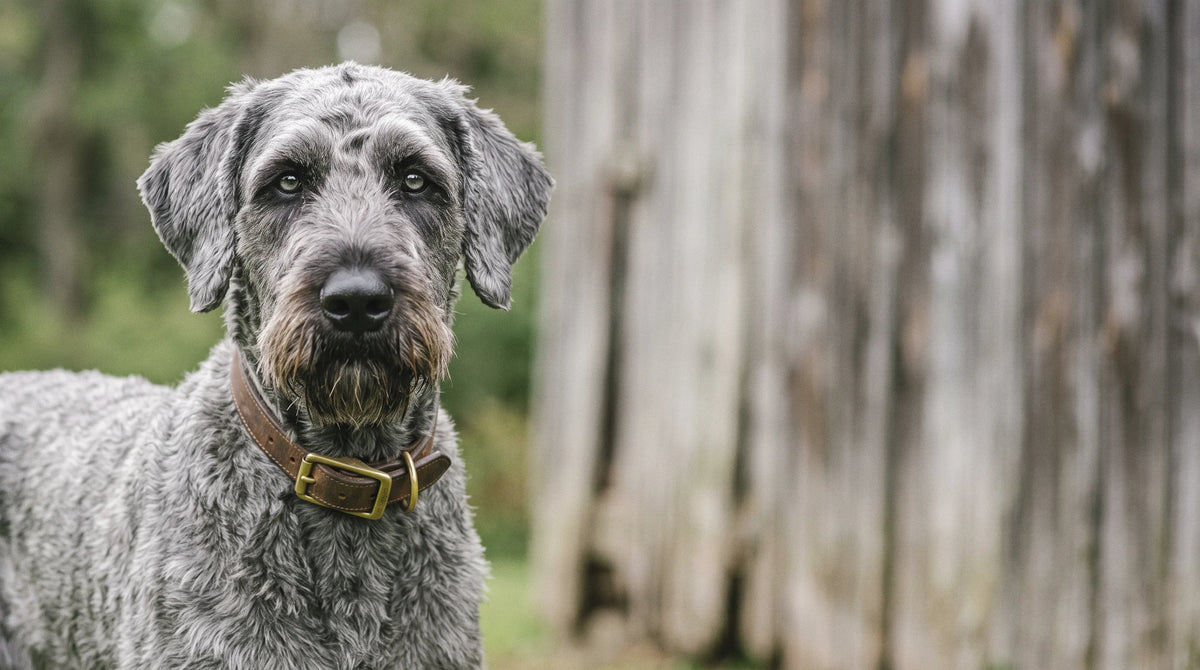
Giant Schnoodle
- Large
The Giant Schnoodle is the largest of the three Schnoodle sizes, reaching 80 pounds from a Giant Schnauzer and Standard Poodle pairing. It is deep-chested, which changes how it should be fed and exercised.
- Weight
- ≤80
- pounds, adult
- Life expectancy
- 10 to 16
- years, median 13
- Senior from
- 9.8
- years, about
Senior starts in the last quarter of a breed's expected lifespan, following the 2019 AAHA canine life stage guidelines. Individual dogs vary.
About the breed
- Temperament
- Intelligent, lively, loving, playful, sociable, trainable
- Coat
- Wavy, Curly, medium
The Giant Schnoodle can weigh as much as 80 pounds, the top of a cross whose documented span runs from around 10. That range exists because both parents come in three sizes, and a Giant Schnoodle is the product of the largest pairing available.
Character does not change with the scale. Schnoodles are smart, loving and level-headed, learn cues fast, and want to be among their people. At 80 pounds those traits matter more, because an untrained dog this size is a different household than an untrained small one.
The deep chest is the specific medical consequence of the size. Standard Poodles and Giant Schnauzers are both at risk of gastric dilatation-volvulus, and a Giant Schnoodle inherits that shape and that risk, which is why the feeding routine below has rules the smaller tiers do not.
The coat runs wavy to curly with some straighter dogs, and there is a great deal of it. Grooming is a standing appointment rather than an occasional errand. Lifespan is 10 to 16 years across the breed, and the largest Schnoodles sit at the lower end of that.
Care
The routines that matter most for this breed. Open one at a time.
Nutrition
Feed a well-balanced food whose label carries an Association of American Feed Control Officials (AAFCO) nutritional adequacy statement for your Giant Schnoodle's life stage, and take the brand question to your vet if you are unsure.
Adults eat twice a day; puppies three or four times on a consistent schedule.
Slow the meal down. A snuffle mat or slow feeder is not optional equipment for this tier, because eating fast is one of the things that brings on bloat in a deep-chested dog. Know the signs while you are at it: a distended stomach, retching, heavy drooling and pacing or an inability to settle mean an emergency vet immediately, since gastric dilatation-volvulus is life-threatening and moves quickly.
Keep the dog lean. Diabetes runs in both parent breeds and joint disease loads directly onto 80 pounds. The bag's guide gives a portion for an ideal weight and your vet gives a better one; supplements stay a vet's call.
Grooming
A Giant Schnoodle is the largest grooming job in the breed, and the schedule is the same as for the smaller sizes rather than easier: a professional groom every four to six weeks and brushing at home a few times a week, ideally daily.
Coats fall between wavy and curly with some straighter individuals, and colour is irrelevant to the effort. On a dog this size a missed fortnight is a mat you cannot brush out.
Skin needs no special routine beyond occasional baths. Abrasions, flaky skin or rashes are worth a vet call.
Wipe under the eyes when tear stains show and report any cloudiness, redness or discharge. Clean the ears every time your dog has been in water, which for a Poodle-descended dog that likes swimming is often, and watch for odour, redness and debris. Brush the teeth daily and trim the nails when they click.
Exercise
A daily walk covers a lot of a Giant Schnoodle's needs, but at this size make it a real one. Both parents are energetic working breeds, and the exuberance a Giant has left over after a short outing goes into the furniture.
Keep hard exercise away from meals. In a deep-chested dog that is a bloat precaution rather than a preference, and it is the one scheduling rule this tier adds.
Agility, nose work, obedience and trick training all suit the intelligence, and swimming and dock diving suit the build. Fetch and tug-of-war fill the gaps.
Giants appreciate room to spread out and run, and while many Schnoodles live happily in apartments, this is the size that most benefits from a yard.
Training
A Giant Schnoodle learns as quickly as its smaller siblings and needs it more. Basic cues come fast and complex tricks follow, all on positive reinforcement, and the work is worth front-loading while the dog is still liftable.
Socialise as a puppy without exception. New people, animals, sounds and situations met early are what make an 80-pound adult polite, and a large dog's rudeness is everyone's problem rather than just yours.
Leash manners deserve their own attention here. A Schnoodle that pulls at 15 pounds is an annoyance; one that pulls at 80 is a walk you stop taking.
Well-socialised Giants get on with children and other pets, and supervision remains the rule with any dog and any child. Keep the mental work going: this breed gets bored before it gets tired.
Health conditions
5 conditions are documented for the Giant Schnoodle.
A predisposition is not a diagnosis. Ask your vet which screenings make sense for your dog's age.
- Bloat (Gastric Dilatation-Volvulus)Digestive
- Diabetes MellitusHormonal
- Elbow DysplasiaBone & Joint
- EpilepsyNervous System & Behavioral
- Hip DysplasiaBone & Joint
May inherit from parent breeds
These conditions are documented in the parent breeds, not in this cross itself. Carrier possible means the condition is recessive: a dog can carry it without showing signs. Ask the breeder which tests the parent dogs had.
- Addison's DiseaseMiniature Poodle, Standard Poodle, Toy Poodle
- BronchiectasisMiniature Poodle, Standard Poodle, Toy Poodle
- Chronic BronchitisMiniature Poodle, Standard Poodle, Toy Poodle
- CryptorchidismMiniature Poodle, Standard Poodle, Toy Poodle
- DystociaMiniature Poodle, Standard Poodle, Toy Poodle
Show all 17 conditions Show fewer
- Ectopic UreterMiniature Poodle, Standard Poodle, Toy Poodle
- Geriatric-onset laryngeal paralysis polyneuropathy, GOLPPMiniature Poodle, Standard Poodle, Toy Poodle
- HypothyroidismGiant Schnauzer, Miniature Schnauzer, Miniature Poodle, Standard Poodle, Toy Poodle, Standard Schnauzer
- Idiopathic epilepsy, including epilepsy of unknown originMiniature Poodle, Standard Poodle, Toy Poodle
- Immune-mediated thrombocytopeniaMiniature Poodle, Standard Poodle, Toy Poodle
- Intervertebral Disc DiseaseMiniature Poodle, Standard Poodle, Toy Poodle
- Noise aversion (noise sensitivity; noise phobia when clinically diagnosed)Miniature Poodle, Standard Poodle, Toy Poodle
- Puerperal hypocalcemia (eclampsia)Miniature Poodle, Standard Poodle, Toy Poodle
- Systemic lupus erythematosusMiniature Poodle, Standard Poodle, Toy Poodle
- Systemic lupus erythematosus-associated polyarthritisMiniature Poodle, Standard Poodle, Toy Poodle
- Tracheal CollapseMiniature Poodle, Standard Poodle, Toy Poodle
- Tracheobronchial Collapse and BronchomalaciaMiniature Poodle, Standard Poodle, Toy Poodle

Longevity & Vitality soft chew
Longevity & Vitality is a daily chew built on five active ingredients. Each chew carries Turkey Tail at 600mg, Curcuvet® curcumin at 75mg, Quercefit® quercetin at 40mg, Fibalance® at 275mg and EpiCor® at 50mg. The daily serving follows your dog's weight, from half a chew to three.
