
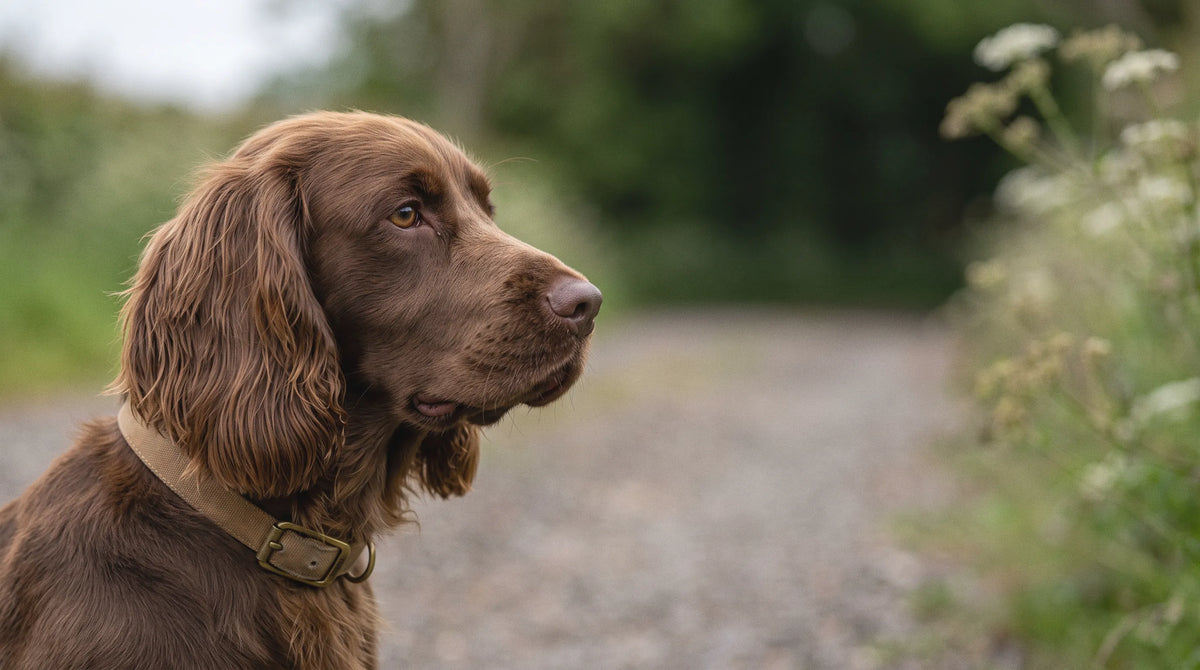
Sussex Spaniel
- Medium
- Sporting Group
- Popularity rank 175
The Sussex Spaniel is a long, low-built bird dog from the south of England, with a deep chest, heavy bone, and a rich golden-liver coat. The breed is steady, affectionate, loyal, and often stays close to its owner.
- Height
- 13 to 15
- inches at the shoulder
- Weight
- 35 to 45
- pounds, adult
- Life expectancy
- 13 to 15
- years, median 14
- Senior from
- 10.5
- years, about
Senior starts in the last quarter of a breed's expected lifespan, following the 2019 AAHA canine life stage guidelines. Individual dogs vary.
About the breed
- Temperament
- Affectionate, Loyal
- Coat
- Double, medium
- Origin
- United Kingdom
- Recognized
- 1878
2015: rank 173, 2016: rank 172, 2017: rank 161, 2018: rank 180, 2019: rank 178, 2020: rank 172, 2021: rank 177, 2022: rank 192, 2023: rank 174, 2024: rank 175, 2025: rank 175
The Sussex Spaniel is a long, low-built bird dog of real strength and endurance. It stands just 13 to 15 inches at the shoulder and weighs 35 to 45 pounds, yet carries a deep chest and heavy bone that make it feel solid for its size. The short legs and rectangular body leave the dog longer than it is tall.
Its trademark is an abundant, feathery coat in rich golden-liver. The classic spaniel head, with wavy-coated ears and big hazel eyes, gives a somber, frowning expression that sits at odds with the breed's cheerful nature.
The Sussex originated in Sussex, England, where it worked as a field dog to find and flush game, and was recognized in 1878. Today this little brown dog is relatively rare in the U.S.
In temperament the Sussex is steady, friendly, and easy to get along with. Rather than independent or aloof, these dogs are loving and enjoy physical contact, and it is not unusual for one to follow a person from room to room.
Temperament and needs
Scored 1 to 5 for the breed overall. Individual dogs vary.
- Affectionate with family5 out of 5
- Good with young children3 out of 5
- Good with other dogs3 out of 5
- Openness to strangers3 out of 5
- Playfulness4 out of 5
- Watchdog and protective nature3 out of 5
- Adaptability2 out of 5
- Trainability3 out of 5
- Energy level3 out of 5
- Mental stimulation needs3 out of 5
- Barking level4 out of 5
- Shedding3 out of 5
- Grooming frequency3 out of 5
- Drooling3 out of 5
Care
The routines that matter most for this breed. Open one at a time.
Nutrition
The Sussex does well on a high-quality dog food, whether commercially manufactured or home-prepared with your veterinarian's supervision and approval. Match the diet to your dog's life stage, whether puppy, adult, or senior. This is a slow-growing breed, and intact Sussex are almost never overweight, since they tend to eat only as much as they need.
A full-grown Sussex usually does well with the daily portion split into two meals, most often one in the morning and one in the evening. To set the amount, start with the feeding guidelines on the food packaging, which suggest a daily amount based on weight, then adjust for your dog's health, activity level, and body condition score. If you are unsure whether you are over- or underfeeding, ask your vet.
Keep clean, fresh water available at all times, and wash the food and water bowls regularly to prevent bacteria and mold. Learn which human foods are safe for dogs and which are not.
Most dogs get all the nutrients they need from a complete and balanced diet. This breed may benefit from certain joint supplements, but give any supplement only on your vet's recommendation.
Grooming
General grooming for the Sussex is bathing, brushing, and combing. Brush a few times a week to keep the coat free of loose hair and dirt, or daily to remove loose hair, reduce shedding, and distribute oils through the coat. A pin brush suits general use, while a slicker brush helps with heavier shedding or serious detangling. Bathing about every other week works well.
The feathering on the ears, legs, and toes is especially prone to matting, so comb those areas diligently and keep them free of debris. Trimming is light and mainly keeps the hair between the toes and around the feet in check, which also stops the dog from slipping; a professional groomer can help. Do not shave the coat down unless absolutely necessary, since it takes a long time to recover. After neutering, the coat can become fuzzy and more difficult to manage.
Trim the nails regularly, since nails that grow too long cause discomfort and trouble walking. Keep the ears clean and dry, since the folded ears can develop infection; if you notice odor or discharge, consult your vet right away and ask which ear-cleaning product to use.
Good dental hygiene matters for long-term health, so brush the teeth at home, ideally daily, and schedule professional cleanings. Also watch the eyes, since an especially droopy lower eyelid can signal ectropion, which can leave the eye dry and irritated.
Exercise
True to its sporting background, the Sussex enjoys hunting, swimming, and retrieving, all good ways to meet daily exercise needs, along with field trials, agility, tracking, and obedience. Expect at least one long walk a day. These dogs are compact and not especially high-energy, but they still need daily activity and a yard to run and play in, so they are not well-suited to small apartments.
Because the breed grows slowly, hold off on strenuous exercise until at least a year old, and let puppies self-exercise through play; jumping and agility-type work should wait until at least 18 months. Adult Sussex love swimming and long walks.
Without enough physical and mental exercise, a Sussex may become restless or destructive through chewing and digging. Pair regular exercise with training and games to keep the mind active.
The even-tempered Sussex is not prone to fear or anxiety, though it can be a bit aloof toward strangers. The breed's initial reserve with strangers usually fades quickly. At home it isn't a big barker, but it is vocal while tracking, with intermittent barks or yips as it follows a bird or rabbit.
Training
The Sussex is intelligent and learns quickly, but it can be stubborn, with a long memory for rough handling. Train with gentle, reward-based methods, using favorite treats, toys, and praise. Show the dog clearly what you want, and praise it when it gets things right. Bred to work in close cooperation with a human hunting partner, it looks for your cues, which makes it relatively easy to train and suitable for many first-time owners.
The Sussex has a well-balanced, laid-back, and loving temperament. Far from being a one-person dog, it shows loyalty and affection for the whole family, including younger members, and is sensitive and gentle toward children.
With other pets, the Sussex generally does fine with dogs but doesn't crave their company; given a choice, most would prefer to be the only pet in the house. Early socialization and obedience training set the dog up to meet new animals well. With smaller animals, keep the prey drive in mind, since cats, rabbits, or guinea pigs can look like a game of chase.
Health conditions
3 conditions are documented for the Sussex Spaniel.
A predisposition is not a diagnosis. Ask your vet which screenings make sense for your dog's age.
- Heart DiseaseHeart
- Hip and Elbow DysplasiaBone & Joint
- Pyruvate Dehydrogenase DeficiencyMetabolic


Sources
Thank you. Your report is in, and we will check this page.
Longevity & Vitality soft chew
Longevity & Vitality is a daily chew built on five active ingredients. Each chew carries Turkey Tail at 600mg, Curcuvet® curcumin at 75mg, Quercefit® quercetin at 40mg, Fibalance® at 275mg and EpiCor® at 50mg. The daily serving follows your dog's weight, from half a chew to three.
